Weekly Economic Update

Labor Markets

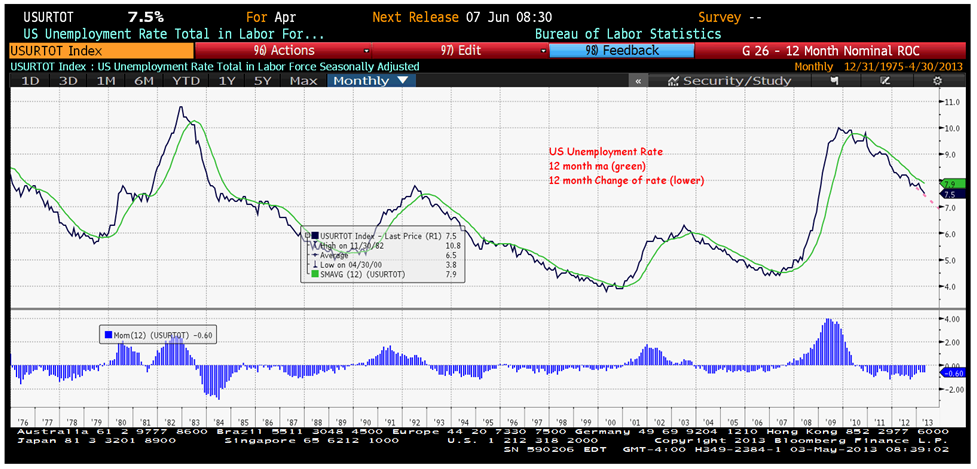
(+) The initial jobless claims number after seasonal adjustment was 340,000 in the week ending May 18, slightly lower than the expected 345,000.  Filing for first-time unemployment insurance benefits fell by 31,000 compared to the same time last year.  The 4-week moving average of initial claims was 339,500 versus 370,250 in 2012.

(+) Continuing claims for the week ending May 11 fell to 2,912,000, better than the median forecasted 3,000,000.  The figure was 3,296,000 in the comparable week in 2012.  For the year-to-date, continuing claims have shrunk by 217,000.

Housing Markets

(+/0) April existing-home sales rose 0.6% to a seasonally adjusted annual rate of 4.97 million, according to the National Association of Realtors.  It is slightly below the expected 4.98 million-unit level.  April’s resale activity is 9.7% higher than the 4.53 million-unit level in April 2012.  Low inventory, tight credit, and 31% more buyer traffic are pushing the national median existing-home price up 11% from April 2012.  The median time on market for all homes was 46 days in April, compared to 83 days in April last year. Continue reading

Posted in Economic News | Leave a comment

Consumer Confidence

cotw


May’s Conference Board Consumer Confidence report is the latest piece of data
to suggest that recent months have seen a significant strengthening of the US
economic cycle and we are unsurprised that the strong rebound in housing,
together with the breakout by the SPX index to all-time highs generated a
substantial upside surprise in the index.

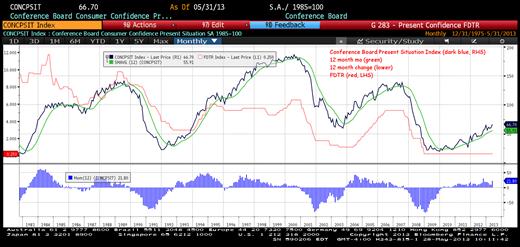
Overall Confidence rose to 76.2 (1985 responses = 100), well above expectations
of 71.2 and the strongest report since February 2008. More interestingly the
Present Situation report led the breakout, Continue reading

Posted in Economic News | Leave a comment

Weekly Economic Update

Economic Update

(+) Retail sales came in quite a bit better than expected for April, with a slight gain of +0.1% for the month relative to a forecasted decline of -0.3%.  In addition, February and March sales were revised upward a few tenths of a percent.  However, the ‘core’ sales number gained a better +0.5% compared to a forecasted +0.3% increase—the headline figure was negatively affected by the weaker net impact of a -4.7% drop in gasoline station sales (which are notoriously volatile and unsurprisingly based on gasoline pricing) and +1% gains in auto and building materials.  In the core, where gasoline wasn’t included, everything else did relatively well:  apparel, ‘general’ merchandise, online sales and electronics all gained about a percent or more for the month.  All-in-all, a decent report that shows some strength to offset a few other flat to disappointing indicators.

(-/0) Business inventories for combined manufacturing, wholesale and retail for March rose less than anticipated, with an unchanged result versus the expected +0.3% gain (a Feb. revision caused that month’s result to end up unchanged as well).  Retail inventories declined -0.5% for the month, in both the auto and non-auto groups.  The inventories-to-sales ratio is well under control, so this isn’t really an outlier of any kind. Continue reading

Posted in Economic News | Leave a comment

Weekly Economic Update

So much economic data was packed into the previous week, last week appeared quite light by comparison.

(+) The Federal Reserve’s Senior Loan Officer Opinion Survey, which polls 68 U.S. banks and 21 domestic branches of foreign banks, has tended to be a good predictor of upcoming business investment.  Over the months between the last survey in January through the current period ending in April, it appears commercial/industrial lending standards have eased (the component of loan ‘supply’) and that a modest increase in demand for loans has taken place across the board as well.

In fact, it demonstrates that the net percentage of banks easing lending terms to mid/large-sized firms has reached its highest level since the third quarter of 2011.  Terms for smaller firms also improved on the magnitude of ~15% fewer loan officers reporting tighter standards (the lowest level since the 2nd quarter of 2005); this segment has experienced a more difficult environment over the last several years compared to the environment for larger companies.  Loan standards and demand for commercial real estate has also dramatically improved over the quarter and year, as did conditions for prime residential mortgages (however, ‘non-traditional’ and sub-prime remained unchanged) and FICO scores continue to be an important factor post-crisis (at least relative to pre-crisis).  In other consumer loan activity, such as installment loans and credit cards, conditions looked to have eased a bit as well although standards here are also at a higher level than they once were.  Another mixed positive is that consumer demand for revolving credit hasn’t moved up dramatically. Continue reading

Posted in Economic News | Leave a comment

Manager Interview with Michael Aronstein MainStay Marketfield

mike


MainStay Marketfield Fund Monthly Commentary

The past month has been characterized by a widespread series of transitions during which poor relative performances have devolved into meaningful absolute losses. One of the side effects of the abundance of central bank manufactured liquidity we have observed is that problems are illuminated initially via relative underperformance among a broad array of asset classes and equity sectors, which heretofore have been costly mostly in terms of lost opportunity. Now, lost opportunity is becoming actual capital loss.

http://www.nylinvestments.com/MainStay/Features/MainStay-Marketfield-Fund


Posted in Fund News | Leave a comment

Weekly Economic Update

It was a busy week from an economic standpoint.

(+) The ISM index for April was a bit better than expected, despite a decline from March’s 51.3 to 50.7 (consensus called for 50.5).  The employment component fell 4 points; however, the look-ahead new orders and production segments rose.  Inventories also declined a bit, which could signify a smaller contribution to this component in Q2 GDP.  This particular ISM isn’t a dramatic change for the month, but the underlying data isn’t terrible, which bucks the fears of a springtime slowdown to some extent (a fear that’s come to pass over the past several years).

(-) Non-manufacturing ISM, by contrast, was a bit weaker than expected, falling from 54.4 in March to 53.1 in April—compared to a consensus estimate of 54.0.  Like the above-mentioned manufacturing ISM, employment declined as did overall business activity.  The inventory component rose, which may temper the need for future production a bit.  Despite the disappointment for the single month, both the manufacturing and non-manuf. ISM’s are solidly above 50—suggesting expansionary territory.

(-) The Chicago PMI came in weaker than anticipated, at 49.0 versus the forecasted 52.5—much in line with other recent regional survey declines.  Employment here, too, by the largest amount, while other components were weaker, albeit less so.  The new orders component was higher, which is a positive from a future perspective.

(+) The Conference Board’s consumer confidence survey posted sharper improvement than expected, with a 68.1 reading, relative to the anticipated 61.0.  The primary catalyst was a higher reading in consumer expectations about the future, which rose by 10%; assessments of current conditions rose by only a percent.  The employment segment that depicts the ease of job market conditions deteriorated a bit. Continue reading

Posted in Economic News | Leave a comment

Non-Farm Payroll Report May 2013

Chart 5-7


April’s Non-Farm Payroll report is a solid set of data that should go a long
way to correcting the unnecessary angst caused by the March report, not least
since that month’s data has now been revised up strongly from 88K to 138K in
Total Payroll and from 95K to 154K in Private Sector gains, making this in
retrospect a normal set of data. This is not the first time Continue reading

Posted in Economic News | Leave a comment

LSA Manager Interview with David Reichart, CFA, CAIA – Principal Funds

David R


David L. Reichart is Head of Business Development for Principal Funds. In this role, he is responsible for the long-term growth of mutual fund products, focusing on specific asset classes and franchise fund products.

Reichart joined the Principal Financial Group® in 1991. Continue reading

Posted in Economic News, Partner News | Leave a comment

FOMC Update

Today, as expected, the Fed Open Market Committee kept the Fed Funds rate on hold (target of 0.00% to 0.25%) and continued their bond-buying program of Treasury and MBS debt on the order of $85 billion a month, although it did allude to the possibility fine-tuning the pace of these purchases as needed.  The FOMC acknowledged that the economy is continuing to expand at a ‘moderate’ pace, as have household spending and business investment, and that labor conditions have shown some improvement as well.  At the same time, government fiscal policy involving the budget isn’t helping matters and the continued high levels of unemployment remain higher than the committee’s comfort zone.  So, business as usual—although the debate about when stimulus should be removed appears to have picked up steam (at least in the media), aside from recent softness in recent numbers in April.  Such soft periods ‘buy’ the Fed time, it seems.

We receive questions occasionally about interest rates and where they’re headed, as well as if this continued stimulus could jumpstart potential inflation.  We have several pieces in the portfolio that are built-in both structurally and in anticipation of possible rising rates (mathematically, the amount of percentage points lying above where we are now is significantly above the number of tics between current rates and the zero bound).  In portfolios, our average duration in the fixed income portion of our portfolios remains quite low, which is a defensive positioning against rising rates, and our use of high yield and floating rate securities provides higher-yielding alternatives to more conventional debt.  We expect that if/when rates move higher over time, perhaps coinciding with more consistent and/or higher economic growth, such positions could prove even more beneficial. 

Inflation remains contained at this time, but is a continual long-term threat to purchasing power (despite the environment).  Specifically, aside from the niche fixed income discussed, assets such as foreign stocks/bonds, real estate and commodities may prove their worth, as could certain types of equities in a diversified portfolio.  Clients may not always remember that story; but the owners of long-term government bonds certainly could feel the pain at that time.

Posted in Economic News | 1 Comment

Weekly Economic Update

(0/-) The advance estimate of real GDP for the first quarter came in a bit weaker than expected, at an annualized +2.5%.  It was better than last quarter’s +0.4%, but a bit slower than the +3.0% consensus estimate.  However, some of the underlying figures were improved (which is why this is considered more of a ‘neutral’ than ‘negative’ assessment).

Within the dataset itself, things looked a bit better.  Personal consumption expenditures were stronger than expected at +3.2% (vs. a forecast of +2.8%), business fixed investment rose just over +2% and final sales rose.  Inventory investment added +1.0% to the bottom line, which stood in contrast to the negative impact it made in Q4.  What accounted for the slight disappointment?  Government spending continued to look weak with both pre-emptive cuts and sequester effects, shaving almost 1% off of GDP—the biggest part of which being defense spending.  The trade deficit widening (more imports than exports) caused a further 0.5% takeaway.  As you can see, those smaller numbers start to add up after a while. 

From a pricing standpoint, the GDP price index grew +1.2%, a tenth of a percentage point under forecast and the Core PCE price index rose by the same amount (a tenth-percent above estimates).  These show that input costs remain contained. Continue reading

Posted in Economic News | Leave a comment

Chart of the Week: Break Even Analysis

chart of the week

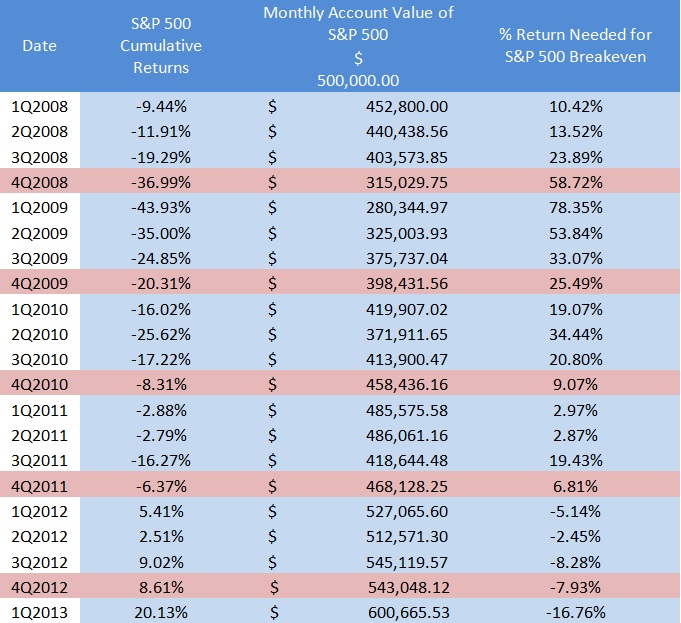
Every quarter LSA will post our Break Even Analysis that shows the impact of drawdown in an account.  The term drawdown refers to the peak to bottom drop an investment experiences or in simple terms what was the biggest percentage loss experienced.    This chart reflects the biggest cumu Continue reading

Posted in Economic News | Leave a comment

First Quarter Market Update with Bud Kasper & Dean Barber

Bud n Dean


LSA has posted the 1Q13 Market update call that Bud and Dean host live for their clients and prospects. This program allows Bud and Dean to communicate with their clients about what is happening in the market place today.  Hear what two leading advisors are saying to clients to keep them informed and confident in their retirement.  To listen to this recording simply log in to the LSA website and click on “Resources/FANN Radio”.

If you are not a member but would like to listen to the show e-mail us at support@lsaportfolios.com .


Posted in Economic News, Partner News | 1 Comment