Today, as expected, the Fed Open Market Committee kept the Fed Funds rate on hold (target of 0.00% to 0.25%) and continued their bond-buying program of Treasury and MBS debt on the order of $85 billion a month, although it did allude to the possibility fine-tuning the pace of these purchases as needed. The FOMC acknowledged that the economy is continuing to expand at a ‘moderate’ pace, as have household spending and business investment, and that labor conditions have shown some improvement as well. At the same time, government fiscal policy involving the budget isn’t helping matters and the continued high levels of unemployment remain higher than the committee’s comfort zone. So, business as usual—although the debate about when stimulus should be removed appears to have picked up steam (at least in the media), aside from recent softness in recent numbers in April. Such soft periods ‘buy’ the Fed time, it seems.
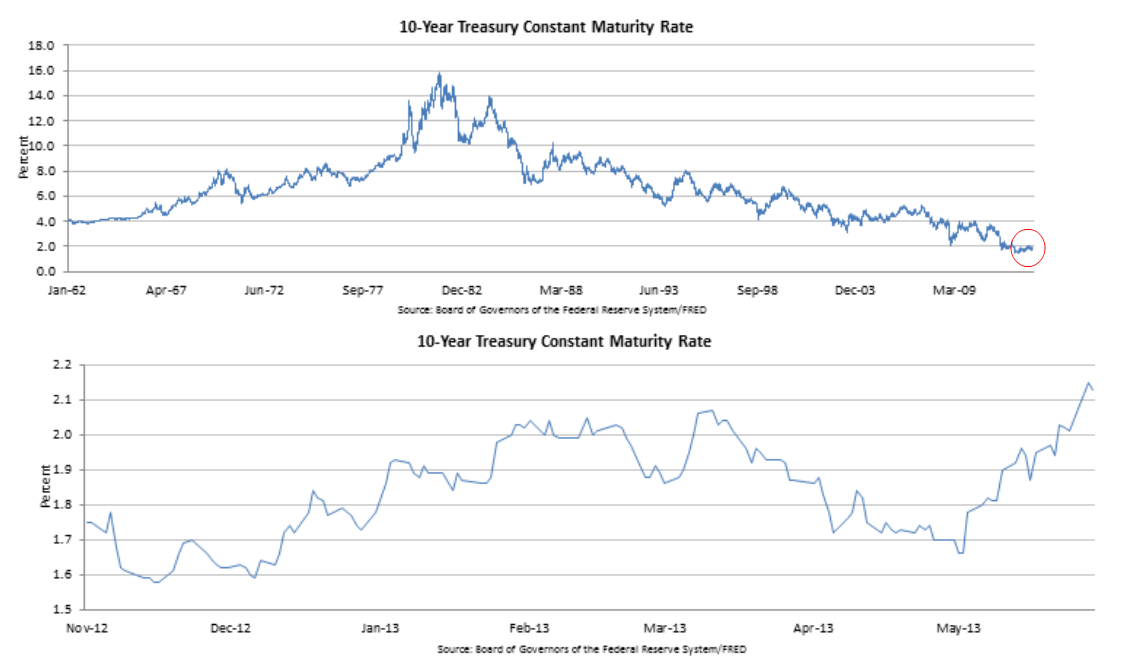
We receive questions occasionally about interest rates and where they’re headed, as well as if this continued stimulus could jumpstart potential inflation. We have several pieces in the portfolio that are built-in both structurally and in anticipation of possible rising rates (mathematically, the amount of percentage points lying above where we are now is significantly above the number of tics between current rates and the zero bound). In portfolios, our average duration in the fixed income portion of our portfolios remains quite low, which is a defensive positioning against rising rates, and our use of high yield and floating rate securities provides higher-yielding alternatives to more conventional debt. We expect that if/when rates move higher over time, perhaps coinciding with more consistent and/or higher economic growth, such positions could prove even more beneficial.
Inflation remains contained at this time, but is a continual long-term threat to purchasing power (despite the environment). Specifically, aside from the niche fixed income discussed, assets such as foreign stocks/bonds, real estate and commodities may prove their worth, as could certain types of equities in a diversified portfolio. Clients may not always remember that story; but the owners of long-term government bonds certainly could feel the pain at that time.