Weekly Economic Update

It was an especially busy week of the month for housing-related data.

(-) Existing home sales rose +0.8% for the month of February, which was a bit light compared to the +1.6% gain expected (however, a revision upward for the prior month partially tempered the disappointment).  Single-family sales were down -0.2%, while condo sales gained +8.8%.  However, this group is much smaller and quite volatile month-to-month—as is all housing data in the short-term, at least to some extent.  The ‘months supply’ of homes on the market rose a bit, by +0.4 months to 4.7 months, although this remains dramatically below levels of recent years.

(0) Housing starts were a bit disappointing for February, with a gain of +0.8% versus an expected +2.8%.  However, the lighter Feb. numbers were offset by a Jan. revision upward—so net-net, everything was in line with expectations.  Single-family starts were up +0.5%, while multi-family gained +1.4%.  The Jan. revision for multi-family was largely a change from a very negative to a less negative number, which gives a sense of the breakdown where building is continuing to occur, albeit choppy from month-to-month.  Over the trailing year, however, total housing starts are up +27.7%, with single-family up +31.5%—both of which are very strong annual results and reflect the continued improvement in the housing space.

(+) Building permits for February are also significantly higher, up +4.6% versus a consensus gain of +2.3%.  Single-family and multi-family rose +2.7% and +8.1%, respectively.  Again, this is in keeping with the recovery trend. Continue reading

Posted in Economic News | Leave a comment

FOMC Update

The Fed Open Market Committee completed their March two-day meeting with no significant changes to their policy or communication to the outside world. However, they did acknowledge an improvement in the nation’s growth prospects (to ‘moderate’), as noted by economic data and survey results in the first few months of this year. (Although not noted in their announcement specifically, the Federal Reserve’s prediction for GDP growth is a central tendency of 2.3-2.8% in 2013, 2.9-3.4% in 2014, and 2.9-3.7% in 2015, as well as unemployment levels in those same years of 7.3-7.5%, 6.7-7.0% and 6.0-6.5%, respectively.)

Nevertheless, the FOMC voted for economic easing to continue for the foreseeable future—which has taken the form of Treasury and mortgage bond purchases in upwards of $85 billion/month. Accordingly, they have continued to reference their policy threshold of a 6.5% unemployment rate, coupled with 1-2 year forward-looking inflation of no greater than 2.5% and ‘well-anchored’ longer-term inflation expectations, as a guideline for a possible exit point.

Esther George, the Kansas City Fed President, was the lone dissenting vote on the grounds that such continued accommodation has the potential for increasing ‘financial imbalances’ including higher inflation expectations. The longer this policy continues, we see more and more debate surrounding potential inflation. While there are market strategists and economists that are convinced that ongoing monetary stimulus has no other outcome than high inflation, as this excess money makes its way downward into the economy and into consumer prices and wages; other academics argue that the ‘hole’ created during the Great Recession was so deep and wide that we are still essentially digging ourselves back to level ground—and banks aren’t helping by keeping lending low (so the money ‘multiplier’ effect isn’t as strong as it normally is). We often think that the biggest threats are those not on the front page of the paper, so perhaps inflation will become a greater concern when it is off the front page and forgotten about yet again.

Posted in Economic News | Leave a comment

Weekly Economic Update

(+) The most heavily-looked at report last week, retail sales, registered a stronger-than-expected result for February, up +1.1% versus a consensus estimate of +0.5%. The headline figure was aided by a +5.0% gain in gas station sales (in line with higher gasoline prices). Auto sales and building materials, both cyclical and choppy month-to-month, were up +1.1% and helped the overall results. The next level of ‘cleaned-up’ data, retail sales ex-autos, gained a still-respectable +1.0% that beat the expected +0.5%. Lastly, the ‘core/control’ retail sales number (which excludes autos, gasoline and building materials, and represents the figure that corresponds most closely to the consumer spending segment of the quarterly GDP report) gained +0.4%, double the expected +0.2% increase. In addition, increases were broad, with strong results in ‘general merchandise,’ food/beverage and online sales. What this tells us is that purchasing activity continues to improve—despite some fears of slowing due to this year’s payroll tax increases. While still fairly low, this remains a tailwind in our favor. Continue reading

Posted in Uncategorized | Leave a comment

LSA FANN Radio “Dow Hits New Highs”

Brad, Bud, Dean

Join Brad Kasper, Dean Barber and Bud Kasper as they discuss the recent market rally and what to keep investors focused on moving forward.

To listen to FANN radio, simply visit the LSA website and login. The show is posted under the “Resources Tab”. If you are not a member but would like to listen to the show e-mail us at support@lsaportfolios.com .

Posted in Uncategorized | Leave a comment

Weekly Economic Update

(+) The ISM Non-Manufacturing Index for February came in better than the expected 55.0 level with a small increase to 56.0. New orders and business activity were higher, while employment deteriorated a bit (although still in expansionary territory). Inventory expansion was also slightly higher. Interestingly, anecdotal comments in the survey responses were optimistic with a general theme that business was ‘picking up’ in several industries in a more diversified way.

(+) Factory orders for January fell -2.0%, which was a touch better than the forecasted decline of -2.2%. A large decline in aircraft orders (defense and non-defense—both of which are a ‘choppy’ series) accounted for a good portion of the result. While ‘core’ (non-defense, non-aircraft) capital goods shipments fell -1.1% during the month, on the positive side, forward-looking core orders came in at a strong +7.2%.

(+) Manufacturing inventories rose +0.5% for January, which was a contrast to a flat reading during the entire fourth quarter of 2012. Nondurable inventories gained +1.0%, which provided the primary magnitude for the change, while durable inventories rose a bit as well. Overall, this was in line with expectations and was considered to be a positive input to the first quarter’s upcoming GDP. Continue reading

Posted in Uncategorized | 1 Comment

LSA Connect On-Demand

Check out our new segment, LSA Connect On-Demand. We will be doing these videos to compliment the content we post on our blog as well. Be looking out for them!

Posted in Uncategorized | Leave a comment

Learn more about LSA Portfolio Analytics

Learn more about LSA Portfolio Analytics by joining our LIVE online demo today, follow the link to register… http://ow.ly/ivUw2

Posted in Uncategorized | Leave a comment

LSA “Chart of the Week”: A Troubling View of Bonds over the Next 4 Years….

chart 1

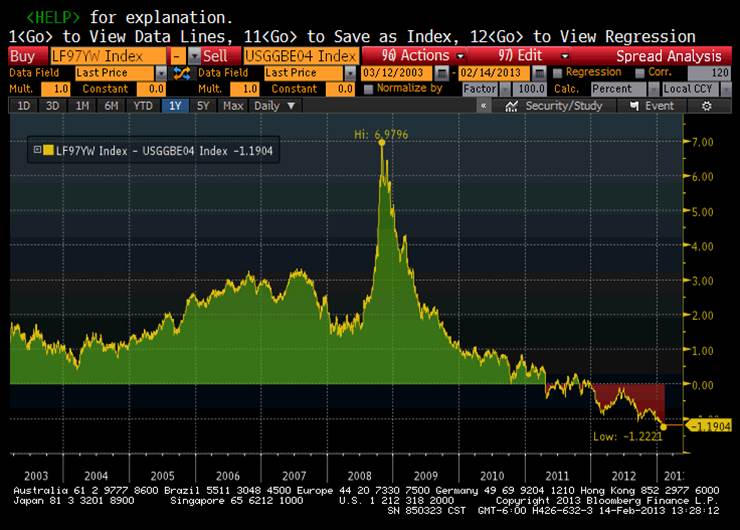
The chart of the week looks at the Yield on the Barclays Intermediate US Government/Credit Index, which is our Fixed Income Benchmark and a good proxy for a conservative bond allocation (60% Treasuries/40% Investment grade corporates) minus the 4 Year Market Implied Inflation rate (subtracting 4 year TIPS yields from 4 year Treasuries yields). The reason we use the 4 year inflation rate is because the weighted average maturity in the Barclays Intermediate US Government/Credit index is 4.18 years, so it is an apples to apples comparison to the 4 year implied inflation rate.

This basically gives you the “real yield” (i.e. after inflation) you can expect from this conservative bond index. As you can see from the chart, the real yield now stands at negative 1.2% and is at the lowest level in 10 years (as far back as our TIPS data goes). This means an investor in a conservative bond portfolio can expect to lose 1.2% of their purchasing power every year on the bond portion of their portfolio if inflation turns out to be 2.4%/year, which is currently implied by the market over the next 4 years:

Posted in Uncategorized | Leave a comment

Weekly Economic Update

The big news of the week from an economic front was arguably the government sequester that took hold as promised on March 1. Interestingly, this strategy has traditionally been considered as an option so unpalatable to politicians that it would force policymakers towards a better way. That ‘better way’ was never agreed upon, so we’re left with an aftermath of cuts. Cuts are incremental in nature, peaking in later 2013 and 2014, and are enough to shave our GDP by ½ a percentage point this year. This wouldn’t be the end of the world in most cases, but with our growth so low anyway, ½ percent is significant. But it’s not too late. Seeing Congress postponing this retroactively wouldn’t be out of the question, and would be entirely within their trend of recent behavior.

Abroad, the Italians made their voices known in a protest vote that led to more gridlock. The success of a populist, anti-establishment/anti-austerity former comedian did not help the situation. Until this gets unraveled, it means several things to the investment world (no surprises here): markets fall—both equities and bonds, as we see yields rise relative to their European counterparts and ‘risk-free’ options like German debt. Now, if the parties can agree to come together to form a functional government (it is unlikely not to happen, at least at some point), markets may respond more favorable when better ‘certainty’ is available. Continue reading

Posted in Economic News | Leave a comment

LSA “Tee Time” demo today.

LSA “Tee Time” demo today. Learn how LSA manages portfolios (Mutual Funds,ETF’s,VA’s)with a Fiduciary-First approach! http://ow.ly/i8llq

Posted in Uncategorized | Leave a comment

LSA “Chart of the Week” Unemployment Suggest the US Recession is Still Around and will be for Awhile….

lsa pic 1

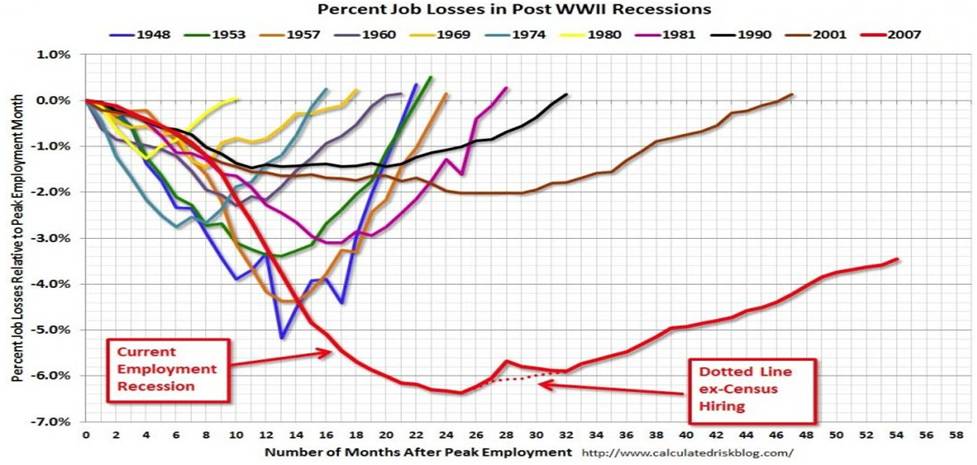
The chart of the week looks at the depth of unemployment post WWII and the time it takes to recover. There are many people talking about the current recovery that is taking place and the positive fundamental shift that is improving the US economy.

That said: December and the unemployment rate ticked up in 7.8 percent.

Although the numbers were in line with economists’ expectations, they still reflect a job market that remains incredibly weak almost four years into the economic recovery and is painting a picture of a continued slow recovery from the 2008 recession.

Posted in Uncategorized | 3 Comments

Weekly Economic Update

0) The CPI inflation number for January was flat, which was a bit less than the slight increase of +0.1% expected. However, the core inflation number—which excludes more volatile food and energy prices—gained +0.3% as opposed to an expected +0.2%. The difference was mainly due to an energy price decline in the headline figure, as well as marginal gains in apparel, tuition/child care and tobacco in the core number. Year-over-year, the headline inflation number was up +1.6% and core +1.9%. Similarly, the Producer Price Index for January rose +0.2% which was a tick below the expected +0.3% increase (and a year-over-year result of +1.4%). The core number rose by an identical amount, in line with expectations.

Overall, inflation results remain well-contained, if the CPI and PPI are used as one’s primary measures. Of course, if one uses one of the many ‘underground’ metrics available, such as one of several historical methodologies or lifestyle-based calculations, you might find a different number—but these are based on different rules and product mixes (one must also account for the technological differences implied in these assumptions). For example, our food might be cheaper, but many of us might argue cable TV, tuition and health care certainly aren’t. It’s hard to find a perfect measure here. But the differences do become important for retirees and future retirees if/when cost of living adjustments for Social Security benefits are tweaked and CPI starts to mean something. Then, those getting the benefits will begin to care about the calculation a lot. In that situation, retirees will naturally benefit from the highest (‘most realistic’) inflation number possible, while it will behoove the government (for program sustainability reasons) to keep these increases as low as possible, which may or may not track the actual inflation many of us experience on a day-to-day basis. Continue reading

Posted in Economic News | Leave a comment