

Steve Roth is a founding member of Dean Capital Management, LLC and serves as the lead Portfolio Manager on the Dean Small Cap Value strategy. He also provides Continue reading
Steve Roth is a founding member of Dean Capital Management, LLC and serves as the lead Portfolio Manager on the Dean Small Cap Value strategy. He also provides Continue reading

Kewjin Yuoh, a Partner and a Portfolio Manager for Taxable Fixed Income, is part of the team managing several Lord Abbett funds, including Core Fixed Income, Income, Total Return, Short Duration Income, and Inflation Focused. Mr. Yuoh directs the Continue reading

Join Brad Kasper and Bud Kasper and they discuss the 401(k) Markets with Founder of RMS Mike Scarborough.
To listen to FANN radio, simply visit the LSA website and login. The show is posted under the “Resources Tab”. If you are not a member but would like to listen to the show e-mail us at support@lsaportfolios.com .
Be sure to subscribe to LSA Connect and if you haven’t already, connect with us on Facebook, Twitter, and LinkedIn for additional resources and information.

The chart of the week looks at the various quantitative easing programs and how they have impacted the markets. It also demonstrates that when these programs end investors Continue reading
It was a downbeat week, at least relative to many so far this year, but we knew there needed to be a pause in the flurry of good news at some point. This did not come as a drastic surprise, as a few positive factors have begun to even out during the last few months and the sequester impact may have started to inch into the underlying data somewhat.
(-) The ISM manufacturing survey came in weaker than expected, which affected market sentiment due to the ISM’s broad following. The index fell to 51.3 compared to a consensus expectation of 54.0, as several underlying components dropped—such as new orders, production as well as inventories. However, the employment segment rose a bit. Overall, with a few monthly exceptions, ISM has remained strong (the true measure is its being above 50—which is the most important part of this diffusion index and signifies a positive result as opposed to negative). In line with other measures, the employment component of this survey has steadily been improving, albeit slowly. It is possible that some seasonal and inventory/price-related effects may have altered the numbers, but that is only speculation at this point.
(-) The March non-manufacturing ISM index fell as well, from February’s 56.0 to 54.4. This was compared to an expected consensus 55.5 reading, so the decline was to a lesser degree than was the manufacturing variety. In this survey, employment fell, as did new orders and overall business activity. While this now stands at a 7-month low, the above-50 reading is still more bullish than bearish. Continue reading
LSA has posted the revisions to the American Fund and Fidelity portfolios, please login to see the updates to begin preparing for TRADING Friday, April 5th, 2013.
** LSA is proud to introduce the Schwab ETF model portfolios to our lineup. To view the newly available models, please login to your LSA webpage and select “Schwab NTF” they will appear in that area. If you do not have Total Access, or a subscription to the Schwab platform and are interested in the ETF models, please contact us and we’ll be happy to set you up with a trial access to view these at your convenience.
Our 2 page Fund Review Fact Sheets are posted for Fidelity and can be found by logging into the LSA site and selecting Fidelity portfolios and clicking on “Portfolio Management.”
If you have any questions please feel free to contact us at support@lsaportfolios.com or call us at (866) 581-5724.
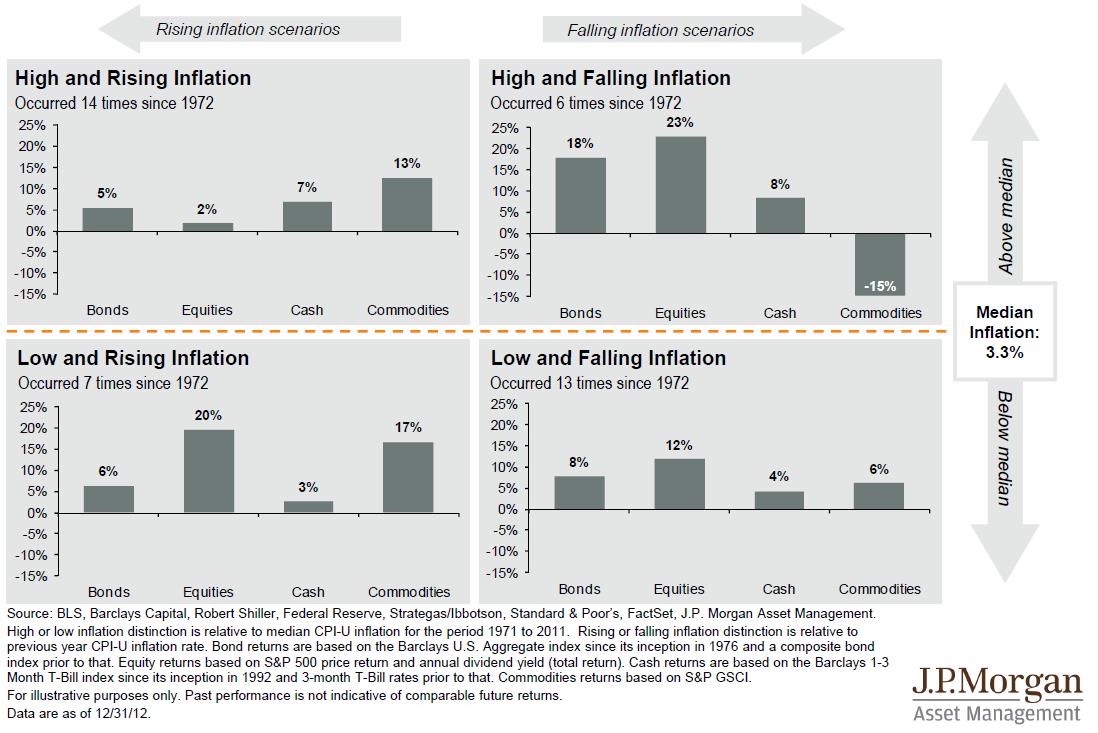
There has been a lot of talk lately about the bond crisis and the potential for a correction. J.P. Morgan created a chat that shows how various asset classes historically react in different types of inflationary environments. Continue reading
(+) Durable goods orders were stronger than expected overall for February, at a gain of +5.7% versus an expected +3.9% increase. The ex-transportation component, however, lost ground of -0.5% for the month, which lagged the forecasted gain of +0.6%. Finally, the ‘core’ capital goods group fell -2.7% versus a consensus drop of -1.1%. In the underlying numbers, several metrics pared back from especially strong results in January, such as machinery orders. On the positive side, shipments for non-defense-related capital goods ex-aircraft (related to the GDP input number) rose +1.9%, which beat expectations by about one-half percent. A somewhat convoluted report, but the trend so far in 2013 has been positive.
(+) Personal income for February gained +1.1%, which was a positive surprise versus the +0.8% expected, and included a +0.6% gain in wage/salary income. Along with the higher income, the savings rate also rose, as did consumer spending—up +0.7%, which was a tenth of a percentage point of a positive surprise. The consumer response didn’t fall off as some expected due to the higher payroll tax rate this year; however, the primary driver for consumer buying was higher gasoline prices, which tends to be the less satisfying kind of spending for most people. The PCE price index, which is used in GDP statistics and differs a bit in the calculation method from CPI, rose +0.39% on the month, which was below the forecasted +0.5% figure. The core version of the same inflation index rose nominally, about 6 hundredths of a percent, just a shade below expected. The difference between the headline and core, naturally, was the higher price of gasoline during the month. Continue reading
LSA has posted the revisions to the Mutual Fund and ETF portfolios, please login to see the updates to begin preparing for TRADING Monday, April 1st, 2013.
At this time we are only making revisions to the MUTUAL FUND and ETF strategies. The up capture of the variable annuities and variable universal life portfolios remain in line. That said this could serve as a good opportunity to rebalance and take some gains off the table.
The video commentary discussing the changes to the models can be viewed by logging into the LSA site with your member codes. The video, as well as the 2 and 6 page Fund Review Fact Sheets, can be found by logging into the LSA site and selecting “Portfolio Management” in the “Monitoring Reports” box after selecting the model portfolios that you wish to view.
Posted March 27th, 2013:
** We are posting these in advance to TRADE on MONDAY, April 1st, 2013 **
If you have any questions please feel free to contact us at support@lsaportfolios.com or call us at (866) 581-5724.
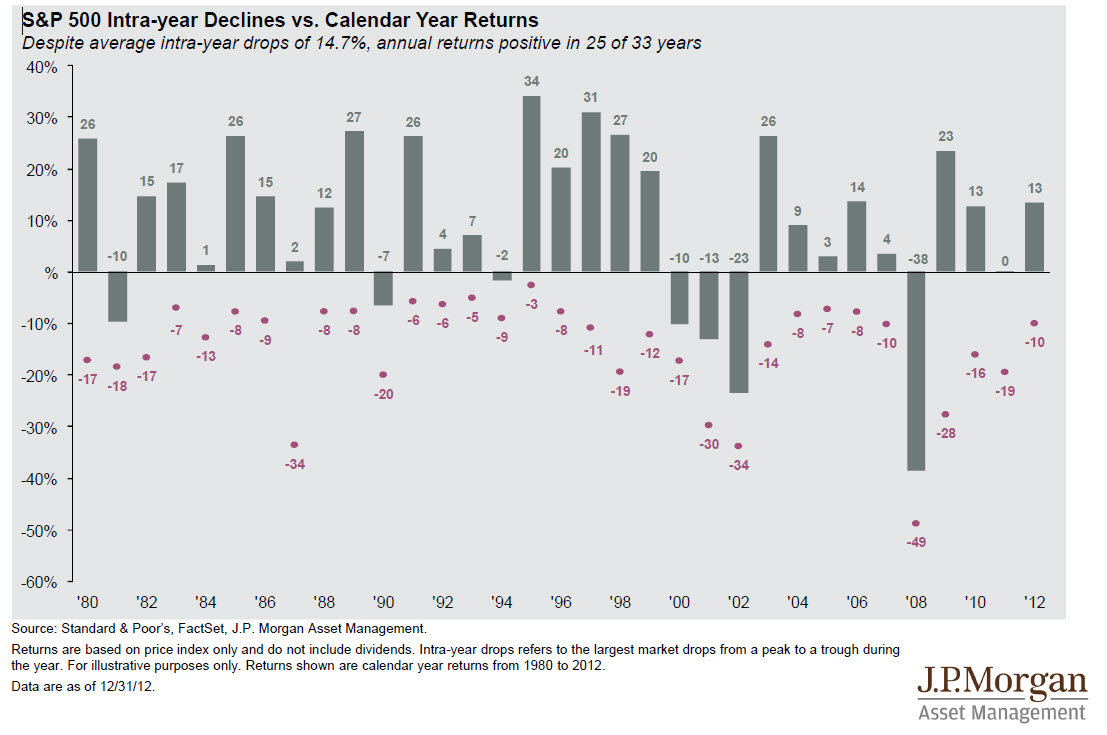
With the recent market rally there has been a lot of talk about the sustainability of this run up. It is important to always take a step back and keep things in perspective. When building an investment strategy, Continue reading
It was an especially busy week of the month for housing-related data.
(-) Existing home sales rose +0.8% for the month of February, which was a bit light compared to the +1.6% gain expected (however, a revision upward for the prior month partially tempered the disappointment). Single-family sales were down -0.2%, while condo sales gained +8.8%. However, this group is much smaller and quite volatile month-to-month—as is all housing data in the short-term, at least to some extent. The ‘months supply’ of homes on the market rose a bit, by +0.4 months to 4.7 months, although this remains dramatically below levels of recent years.
(0) Housing starts were a bit disappointing for February, with a gain of +0.8% versus an expected +2.8%. However, the lighter Feb. numbers were offset by a Jan. revision upward—so net-net, everything was in line with expectations. Single-family starts were up +0.5%, while multi-family gained +1.4%. The Jan. revision for multi-family was largely a change from a very negative to a less negative number, which gives a sense of the breakdown where building is continuing to occur, albeit choppy from month-to-month. Over the trailing year, however, total housing starts are up +27.7%, with single-family up +31.5%—both of which are very strong annual results and reflect the continued improvement in the housing space.
(+) Building permits for February are also significantly higher, up +4.6% versus a consensus gain of +2.3%. Single-family and multi-family rose +2.7% and +8.1%, respectively. Again, this is in keeping with the recovery trend. Continue reading
The Fed Open Market Committee completed their March two-day meeting with no significant changes to their policy or communication to the outside world. However, they did acknowledge an improvement in the nation’s growth prospects (to ‘moderate’), as noted by economic data and survey results in the first few months of this year. (Although not noted in their announcement specifically, the Federal Reserve’s prediction for GDP growth is a central tendency of 2.3-2.8% in 2013, 2.9-3.4% in 2014, and 2.9-3.7% in 2015, as well as unemployment levels in those same years of 7.3-7.5%, 6.7-7.0% and 6.0-6.5%, respectively.)
Nevertheless, the FOMC voted for economic easing to continue for the foreseeable future—which has taken the form of Treasury and mortgage bond purchases in upwards of $85 billion/month. Accordingly, they have continued to reference their policy threshold of a 6.5% unemployment rate, coupled with 1-2 year forward-looking inflation of no greater than 2.5% and ‘well-anchored’ longer-term inflation expectations, as a guideline for a possible exit point.
Esther George, the Kansas City Fed President, was the lone dissenting vote on the grounds that such continued accommodation has the potential for increasing ‘financial imbalances’ including higher inflation expectations. The longer this policy continues, we see more and more debate surrounding potential inflation. While there are market strategists and economists that are convinced that ongoing monetary stimulus has no other outcome than high inflation, as this excess money makes its way downward into the economy and into consumer prices and wages; other academics argue that the ‘hole’ created during the Great Recession was so deep and wide that we are still essentially digging ourselves back to level ground—and banks aren’t helping by keeping lending low (so the money ‘multiplier’ effect isn’t as strong as it normally is). We often think that the biggest threats are those not on the front page of the paper, so perhaps inflation will become a greater concern when it is off the front page and forgotten about yet again.



 LSA Connect