Weekly Economic Update

Global investors were relieved when President Obama signed H.R. 2775 into law last Thursday, effectively ending the government shutdown and funding it through Jan. 15, 2014.  The law also extends the country’s debt limit through Feb. 7, 2014.

Due to the shutdown, several federal agencies were unable to release September economic reports on measurements such as CPI, housing starts, industrial production and capacity utilization.  Therefore, we can only digest a shorter list of economic data for our note.

(-) The National Association of Home Builders Housing Market Index (NAHB HMI), which acts a leading indicator of housing starts going forwar Continue reading

Posted in Economic News | Tagged , , , | Leave a comment

Economic Update

Sadly, the effects of the government shutdown are finally starting to trickle down to our weekly review.  Since the federal government is responsible for compiling a fair number of these releases, we have just a few economic data points available for last week.

We would have normally expected results for September retail sales (a closely-watched indicator for domestic commerce), details of the trade deficit, wholesale inventories and the producer price index; unfortunately, none were to be, so we may have a very busy next week or the week after, depending on how long the shutdown lasts.  But, as time passes, the data becomes less relevant and is less likely to impact the market.  Such is the reality of economic statistics—a lot of effort to compile, then a few minutes of review, and markets price it in and move on to the next piece of news.

Interestingly (since we had the extra space to explore such things), a study put out by the New York Fed recently looked at the timeliness and magnitude of market responses to various economic releases.  As might be expected, the most useful information came from data that’s more precise as opposed to vague (and subject to smaller revisions later), more information-packed than not (as in a more direct correlation to forecasting GDP growth, inflation, etc.) or could affect future asset behavior in some way (as opposed to what’s already happened).  While there are some general market ‘rules’ that have developed over time for what is ‘good’ news as opposed to ‘bad’ news, much of this data is relative and ever changing.  For example, what might be a great jobs number one year might not be celebrated the same way a few years later under different conditions/expectations.  The Fed study focused mostly on government releases, but in other work, private releases such as the ISM manufacturing and Chicago PMI surveys also belong on a short list.  Continue reading

Posted in Economic News | Leave a comment

Hatteras Funds Group

HATTERAS FUNDS GROUP TO BE ACQUIRED BY RCS CAPITAL CORPORATION

RCS Capital Increases its Exposure to Alternative Investments with Acquisition of Hatteras, a Boutique Alternative Investment Specialist Existing Hatteras Leadership Team to Remain Autonomous RCAP to Provide Access to Integrated Distribution Platform and Financial and Strategic Support New York, NY, and Raleigh, NC, October 1, 2013 – Hatteras Funds Group, a boutique alternative investment specialist providing unique alternative investment solutions to financial advisors and their clients, has entered

into a definitive agreement with RCS Capital Corporation (“RCAP”) (NYSE: RCAP). Following this transaction, the Hatteras Funds Group, which recently celebrated its 10-year anniversary, will continue to operate autonomously under its current management team as a subsidiary of RCAP.

The acquisition will provide significant financial resources to the Hatteras Funds Group, enhancing the firm’s competitive strength and allowing it to expand its alternative investments platform. Hatteras will join RCAP’s existing subsidiaries Realty Capital Securities, LLC, their wholesale distribution and investment banking /capital markets business, RCS Advisory Services LLC, their transaction management business, and American National Stock Transfer, LLC, their stock transfer business. Continue reading

Posted in Fund News | Leave a comment

Weekly Economic Update

(+) The ISM manufacturing index for September was a bit stronger than anticipated, rising from 0.5 points from August, coming in at 56.2 versus an expected 55.0.  This is the highest point for the ISM since April 2011.  The details weren’t quite as dynamic as the headline, with declines in new orders but better numbers from employment, production and inventories.

(-) Conversely, the ISM non-manufacturing survey was weaker than expected, falling from 58.6 in August to 54.4 for September, and fell short of an expected 57.0 reading.  Business activity and employment both fell, as did new orders sligh Continue reading

Posted in Economic News | Tagged , , , , | Leave a comment

Government Shutdown

Should I worry about the government shutting down (again) or defaulting on its debt?

You would think we’d get used to this by now, as many Americans have grown tired of these congressional battles—which they view as petty and unnecessary.  You might wonder why we choose to spend any time at all on political items like this relative to our usual discussions of the economy and investment markets.  From an economic standpoint most directly, government expenditures represent 20% of GDP and a government shutdown would directly affect Federal government discretionary spending, which represents almost 40% of non-interest expenditures.  A few days of closure wouldn’t do a lot, but a few weeks might make a dent.

Unfortunately, perceptions of these events can also have secondary effects.  They can trickle down to lessened certainty about forward-looking prospects about the economy (legitimate long-term fear or not), which can potentially erode overall sentiment about business and job prospects, which can suppress private spending, which can hold back corporate revenues, which can pressure profits, which can hold back economic growth.  You can see how a negative feedback loop can easily begin if sentiment surrounding such issues becomes too negative, which is why economists pay attention to things like this.

Many Washington experts view the recent round as a political repeat of what’s been happening on almost a continuous basis.  During a recent conference call we happened to sit in on, a political analyst at Fidelity noted that the ‘system is broken and participants are flawed,’ which we think echoes much of Main Street America’s opinion (bolstered by anecdotal comments advisors share with us from clients, some of which colors their investment views).

Without getting into procedural minutia, there are a few elements critical to the current debate.  One is more immediate (as in today, Sept. 30, the last day of the government fiscal year), when the continuing resolution that kept the Federal government running comes to an end.  A resolution stop-gap had to be put in place since a budget wasn’t officially passed last year.  If nothing is passed today, like a new resolution or full budget, the government shuts down due to lack of funding.  This isn’t unprecedented—it happened most recently for a total of 28 days in Dec. 1995-Jan. 1996 during the Clinton vs. Gingrich political battles—but has actually happened 17 times since 1976, ranging from 1 to 21 days in a stretch.  It also won’t stop the Earth from rotating, but can lead to more hard feelings and even less confidence in government, which of course can trickle down to markets as noted above. Continue reading

Posted in Economic News | Leave a comment

Weekly Economic Update

(0) The 3rd and final estimate of GDP growth was unchanged from the second estimate of +2.5%, despite consensus assumptions for a slight increase to +2.6%.  Inventory investment was revised downward slightly while state/local spending were bumped up a bit, but these were tiny adjustments.  This is certainly old news now, as third quarter GDP is anticipated to fall in the 1.5-2.5% growth range—so slightly worse than last quarter—while fourth quarter growth has been estimated in the 2.5-3.0% area.  Next year looks markedly better—several assessments point to over-3% expansion, but we know how often these estimates change.

(0) Durable goods orders came in just a bit better than expectations in August, growing +0.1% versus a forecasted slight decline of -0.2%.  Removing transports from the group took the core bottom line to a -0.1% decline, wh Continue reading

Posted in Economic News | Tagged , , , | Leave a comment

Weekly Economic Update

The biggest news of the week was the FOMC meeting, press release and news conference, but we won’t rehash our earlier note of the week.  Long-story short, the ‘taper’ is postponed for now, and that drove sentiment (up) much more than did the underlying economic data last week.  Since most market participants appeared to be prepared for the taper, it is again a reminder that markets react most convincingly to surprises and resolution to the previously unknown.

(0) The consumer price index for August rose +0.1%, about half of the expected increase (bringing year-over-year inflation to +1.5%).  Stripping out food and energy, core CPI gained +0.13% compared to an anticipated +0.2% (12-month gain of +1.8%).  The amounts are so small these days that they’re practically quoted in hundredths of a percent.  From an individual component level, airline prices fell -3% for the month, while medical services increased about a percent, and rent of primary residence gained just under a half-percent.  However, changes overall were fairly minor

(0) Industrial production for August gained +0.4%, which was just a tick below consensus, and July’s figure was revised downward by a few tenths.  Manufacturing production, which is the bulk of the number, rose +0.7% on the back of stronger auto and auto parts production during the month.  Auto assemblies have jumped to a post-recession high.  Capacity utilization came in at 77.8%, which also underwhelmed expectations by a similar tick.

(-) The Empire manufacturing index for the New York Fed region came in at +6.3 for September—below August’s +8.2 and an anticipated +9.1 result.  The underlying components were mixed, with improvements in shipments and new orders, as well as expectations for business condition improvement going out six months, but a deterioration in employment.

(+) The Philly Fed index, by contrast, rose to its highest level in 2 ½ years to +22.3 compared an expected +10.3 reading.  Similarly to the Empire, new orders and shipments rose but employment also improved.  Expectations looking out six months were better here, too.

(+) Existing home sales for August again rose +1.7%, which was a pleasant surprise over the forecasted -2.6% drop after a big July reading.  Single-family and co-op/condo sales posted nearly similar results, so no story here.  The months’ supply of homes ticked down a bit to 4.9.

(0) The NAHB housing market index for September came in unchanged from the prior month at 58, which was in line with expectations.  Builder assessments of current conditions were also unchanged, prospective buyer traffic ticked up, while expectations for forward-looking future conditions deteriorated slightly.

(-) Housing starts came in weaker than expected, gaining +0.9% for August compared to a consensus of +2.3%.  The always-interesting multi-family segment was responsible for the drop (down -11%), while single-family was up +7% to partially offset this, at a five-month high.  Building permits were also weaker, falling -3.8% month-over-month compared to a forecasted -0.4% decline, with characteristics similar to the starts numbers—lower multi-family and much stronger single-family (a post-recession high in fact, for the latter).

Despite the leveling off in recent months, general housing numbers have shown a solid year-over-year growth trend.  While the strong upward pace seen earlier in the year was probably not sustainable (and wasn’t), continued housing improvement appears more likely than not due to demographic tailwinds (we need more housing to keep up with population growth).  While pricing and sales levels are back up towards more normal levels, construction remains about 40% below long-term ‘normal.’  However, despite some debate over the topic, it seems higher mortgage rates over the past few months may have contributed to some of this tempering.  While this doesn’t seem like a lot in percentage rate terms, as rates are generally low versus history, a few hundred dollars a month in a mortgage payment represents a significant amount for most Americans.  The Fed was likely focused on this in their decision to hold off on the taper, and even made mention of it in their statement.

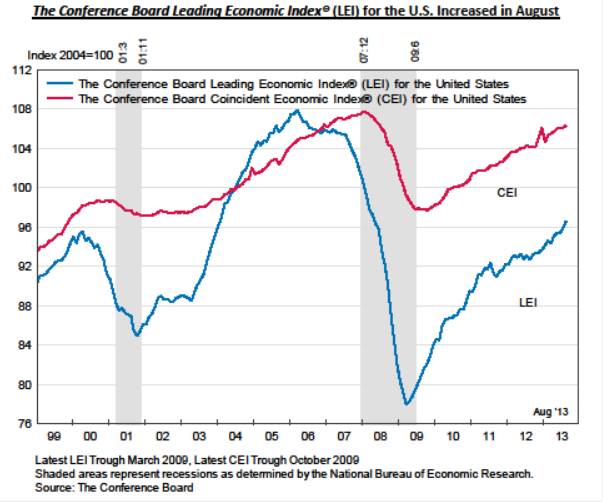
(+) The Conference Board’s index of leading economic indicators increased +0.7% in August, which indicates some momentum compared to a slightly lower gain in July and flat reading in June.  Gains were largely driven by improvements in the interest rate spread, ISM new orders, workweek length and unemployment claims; while building permits and stock prices detracted.  Also tracked by the Board, the index of coincident and lagging economic indicators, rose +0.2% and +0.3% for Aug., respectively.
Pic 1

(0) Initial jobless claims for the Sept. 14 week came in at 309k, which was far below consensus expectations for 330k.  However, it was too good to be true yet again, as the second week in a row of claims reporting distortions convoluted the numbers due to state system upgrades.  Since California was one of the states behind the problem, the room for error could be significant.  Continuing claims for the Sept. 7 week came in at 2,787k, which were also lower than the 2,900k expected.  However, due to the missing data, the entire report should probably be disregarded for now.

Lastly, as we enter the end of September, we’re approaching the Federal fiscal deadline… so expect contentious battles in Congress regarding the new budget and raising of the debt limit.  Based on past experience over the last few years, we may be in for some volatility (although we’ll make the leap that leaders have the common sense to avoid conditions for an outright U.S. debt default).  On the positive side of this, our fiscal situation (deficit) has improved, through better economic growth (leading to better tax receipts) and the tempered effects of sequestration (despite the horrible environment it was supposed to create).

And truly lastly, upcoming German elections on Sunday could have been a potential source of volatility—but only if things didn’t go as expected (Merkel being elected to a third term, which she was).  She has been supportive of Eurozone efforts to sustain the union, but German citizens appear continually uneasy about their economic leadership role in the region and have been openly skeptical about bailing out their Southern European neighbors.  She has balanced these concerns so far, and kept the confidence of the electorate.

Period ending 9/20/2013

1 Week (%)

YTD (%)

DJIA

0.50

20.13

S&P 500

1.32

21.76

Russell 2000

1.81

27.49

MSCI-EAFE

2.81

17.12

MSCI-EM

2.67

-3.98

BarCap U.S. Aggregate

0.98

-2.39


U.S. Treasury Yields

3 Mo.

2 Yr.

5 Yr.

10 Yr.

30 Yr.

12/31/2012

0.05

0.25

0.72

1.78

2.95

9/13/2013

0.01

0.45

1.71

2.90

3.84

9/20/2013

0.01

0.34

1.50

2.75

3.77

Posted in Economic News | Tagged , , , , | Leave a comment

Fed Update

There hasn’t been this much excitement over a Federal Reserve meeting in quite some time.  The FOMC concluded their September event today and all eyes were on the finale of the ‘taper caper’ (yes, I’m afraid I made that up).

Surprise!  Despite what many economists largely expected, the Fed decided not to pull back on their quantitative easing program of ongo Continue reading

Posted in Economic News | Tagged , , | Leave a comment

Weekly Economic Update

Economic data was being watched perhaps a bit more closely this last week with the Fed meeting upcoming and talk of the ‘taper’ hanging in the balance.

(-) Retail sales for August gained a meager +0.2%, which disappointed a bit relative to the expected +0.5% increase.  Removing auto and gasoline components brought the core sales number to +0.2%, which still trailed the anticipated number by a tenth.  On the positive side, June’s gain was revised upward by a tenth, although we’re talking about fairly small numbers all the way around.  In August, apparel sales and building materials were disappointing, down almost a percent in the u Continue reading

Posted in Economic News | Tagged , , , | Leave a comment

Weekly Economic Update

Despite the Labor Day-shortened week, several important releases kicked off the fall market season (traditionally the week where everyone on Wall Street gets ‘back to business’).

(+) The ISM manufacturing index for August came in better than expected for August, rising from 55.4 to 55.7 (while expectations called for a 54.0 reading) and bringing the index to its highest level since June 2011.  In the underlying detail, new orders gained while employment and production both declined (however, all three remained over 50—a positive indicator in a diffusion index).

(+) Non-manufacturing ISM also came in strong for August, rising from July’s reading of 56.0 to 58.6, versus a median forecasted level of a slig Continue reading

Posted in Economic News | Tagged , , , | Leave a comment

Weekly Economic Update

(-) Durable goods orders for July came in weaker than expected, falling -7.3% relative to a consensus forecast decline of -4.0%.  Removing transportation from the headline figure, orders fell a much less dramatic -0.6%, but underperformed an expected +0.5% gain for the series.  The difference was caused by a -52% decline in the volatile non-defense aircraft category—notably by a drop-off in Boeing aircraft orders.  At the same time, core capital goods (notably in compute Continue reading

Posted in Economic News | Tagged , , , , | Leave a comment

Weekly Economic Update

It was a relatively light week for economic reports.  Unfortunately, a few weak data points this last week and in recent weeks have been steadily eroding economist GDP estimates for the coming quarter, although growth for the second half is expected to be better than what we saw in the first half.

(+) The FHFA house price index, which measures prices of homes financed with conforming mortgages, rose +0.7% for June and slightly beat the median forecast +0.6%.  By region, the strongest gains were located in the East South Central (KY, TN, MS, AL) and Pacific (HI, AK, WA, OR, CA) regions—both up around +1.5% on the month.  The Pacific and Mountain (MT, ID, WY, NV, UT, CO, AZ, NM) regions that were so heavily hit during the housing crisis have shown the strongest regional year-over-year gains, while the nation as a whole rose +8% for the year.  Nevertheless, the index remains about 10% below the pre-crisis peak.

(+) Existing home sales rose more than expected for July, up +6.5% versus a forecast +1.4%, as single-family homes and condos/co-ops both rose in the upper single-digits.  The July result brought the rolling twelve-mo Continue reading

Posted in Economic News | Tagged , , , , , , | Leave a comment