Weekly Economic Update

Economic Update 6-22-2015

  • Economic data for the week was somewhat mixed in both the industrial and housing areas; this fell along the same theme leading to inaction by the Fed following the week’s FOMC meeting.
  • Equity markets rose in the U.S., while foreign equities fell back.  Fixed income generally benefitted across the board from lower interest rates and, abroad, from a weaker dollar.  Commodities were mixed to negative as crude oil prices remained contained with a recent tighter range.

Continue reading

Posted in Economic News | Tagged , , , , , , , , , , , , , , , , , , , , , , , , , , , , , , , , , , , , , , , , , , , , , , , , | Leave a comment

Fed Note

Since the start of the year, investors and economists have been focused on this month’s FOMC meeting; specifically, whether or not this would be ‘the one’—the meeting that announced a change in regime, from extreme emergency accommodative low rates to the start of tightening.  Due to sporadic data since that time, it became more obvious over time that it was not to be.

The statement language reflected a moderate expansion of economic growth and job gains in recent months, while acknowledging the mixed nature of consumer spending, housing and business capex.

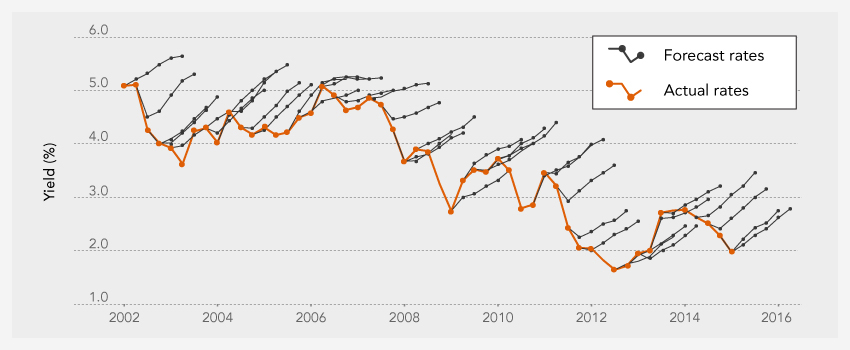
Many look at the ‘dot plot,’ which is a graph attached to the official statement showing the path of rates expected by FOMC members over the next several years—changes in these dots from last meeting are interpreted as a sentiment shift.  As it stands, it appears the general expectation is a raising of rates twice by the end of 2015 (probably in the fall, as the July meeting doesn’t feature a press conference).  It’s almost hard to believe, but two years hence—by end of 2017—members expect fed funds rates to be at 3% or so (given a range of +/- 0.5% in either direction).

A look at the dashboard: Continue reading

Posted in Economic News | Tagged , , , | Leave a comment

Weekly Economic Update

Economic Update 6-15-2015

  • Economic data from last week looked a bit stronger, with some positive surprises from retail sales and a few sentiment surveys; the JOLTs and jobless claims reports, however, disappointed.
  • Despite some day-to-day volatility in equity markets and recent trends higher for interest rates, on net, U.S. stock and bond markets ended very little changed.  However, a falling dollar helped foreign indexes inch higher.  Commodities also gained, led by stronger pricing in energy.

Continue reading

Posted in Economic News | Tagged , , , , , , , , , , , , , , , , , , , , , , , , , , , , , , , , , , , , , , , , | Leave a comment

Weekly Economic Update

Economic Update 6-08-2015

  • Economic data last week was mixed to decent, with the headline ISM manufacturing figures, construction spending and vehicle sales coming in better than expected.  The employment situation report was also stronger than anticipated.
  • Equities experienced a more difficult week, with negative returns throughout the globe.  Rising interest rates were a concern, affecting bond prices dramatically.  Commodity index returns were down on net, with crude oil down slightly.

Continue reading

Posted in Economic News | Tagged , , , , , , , , , , , , , , , , , , , , , , , , , , , , , , , , , , , , | Leave a comment

LSA Revisions – Trade Day!

Below is a list of all models that are scheduled to trade today……June 8th, 2015.  All revisions for these models have been posted and are ready to view.

*As a reminder, the Revision Explanation Presentation/Video will be posted later today.  We will be sending out another email notifying you when it is posted.  Once posted, it can be viewed via e-mail or on the LSA website.

** TRADE DATE SCHEDULED FOR TODAY…….. JUNE 8, 2015! **

A brief summary of the changes are below.  There will be a more detailed explanation to follow.

  • LSA Affected Models
  1. Private Client (Inclusive of NTF Models), Schwab NTF, Fidelity NTF, TDA NTF
  2. Private Client Traditional (Inclusive of NTF Models), Schwab NTF, Fidelity NTF, TDA NTF
  3. Private Client Tax Efficient (Inclusive of NTF Models)

If you have any questions please feel free to contact us at support@LSAportfolios.com or call us at 866-581-5724.

Posted in Uncategorized | Leave a comment

Chart of the Week: Putting the Rise of the Dollar in Perspective

Chart of the Week: Putting the Rise of the Dollar in Perspective

dollar

Since its low in 2011, the US dollar is up 31%, and in the past eight months has risen at a pace faster than we have seen in forty years. The rapid rise continues to be one of the greatest concerns to the health of the world economy, some even dubbing it the cause of the next global financial crisis. However, as this chart shows, these kinds of cycles in the currency market are not uncommon. Pain will be felt in corporate profits, as international sales are lower when converted back to a strengthening dollar, but this will not have a large impact on the overall economy in the long run. As the US continues gaining strength in its recovery and international countries continue to lag behind, the increase in the dollar is a normal economic process. The rapidity of the rise is alarming, however, as growth improves in Europe and emerging markets the pace should moderate. For now, it is best to view it as more of a tailwind for international countries than a headwind for the US economy. A rising tide lifts all boats.

Posted in Research | Leave a comment

Weekly Economic Update

Economic Update 6-01-2015

  • Economic data from last week was lackluster on the manufacturing front, with poor durable goods and PMI figures, as well as a negative shot to sentiment with a negative 1stquarter GDP growth revision, while housing and consumer confidence improved.
  • Equity markets experienced a negative week globally, with the mixed economic news and uncertainty over European negotiations with Greece. Being a risk-off week, bonds were the sole positive group, with U.S. debt faring better than foreign with the dollar coming off stronger. Commodities were down slightly, although oil experienced little volatility.

Continue reading

Posted in Economic News | Tagged , , , , , , , , , , , , , , , , , , , , , , , , , , , , , , , , , | Leave a comment

LSA Exclusive: Live Interview with Samuel Wardwell


SW LSA connect

Date: Thursday, May 28th

Time: 10:00 AM CT

Click here to register today!

LSA is excited to provide an exclusive webinar featuring the always entertaining Sam Wardwell. Sam is responsible for monitoring economic and market developments and communicating updates on financial market performance, economic trends, and the firm’s outlook and portfolio positioning to clients and their advisers. He travels nationally and internationally to meet with advisers and investors and is a sought-after speaker on the markets, the economy, and the firm’s investment strategies. Sam has spoken multiple times at the LSA National Conference and is always one of the most popular speakers at the event. To view Sam’s bio, please CLICK HERE.

We hope you are able to attend! 

Posted in Research | Tagged , , , | Leave a comment

Weekly Economic Update

Economic Update 5-26-2015

  • Economic results were again mixed, with some improvement in housing, tempered overall but higher core CPI inflation readings and stronger jobless claim data.
  • U.S. equity markets on average were slightly higher, while foreign equities ended up negative due to the influence of a stronger U.S. dollar that eroded the impact of a much better week in local terms.  Higher interest rates generally pressured bonds and real estate, while commodities also lost some ground on average.

Continue reading

Posted in Economic News | Tagged , , , , , , , , , , , , , , , , , , , , , , , , , , , , , , , , , , , , , , , , | Leave a comment

Weekly Economic Update

Economic Update 5-18-2015

  • Economic data for the week was mixed, with weaker-than-expected retail sales numbers, decent employment metrics and conflicting sentiment data from consumers and small businesses.
  • Global equities gained on the week, with international stocks outperforming U.S. names—due to a weakening dollar effect—both despite a lack of major headline data to move sentiment in either direction.  Global bond yields jumped mid-week but came back to earth, in both U.S. and foreign markets, which resulted in generally flat domestic returns and slightly better for foreign bonds, which benefitted from a weaker dollar.  Commodities rose a bit, with oil price stability and some gains in gold.

Continue reading

Posted in Economic News | Tagged , , , , , , , , , , , , , , , , , , , , , , , , , , , , , , , , , , , | Leave a comment

Chart of the Week: Is QE Driving Economic Growth?

Monetary Base

LSA would like to offer a special thanks to renowned economist Brian Wesbury for taking the time to update us on his thoughts of his self-coined ‘plow horse’ economy. In this update, Wesbury addresses the notion that, in our current economy, the record gains in the stock market are a product of quantitative easing. He uses the chart above to refute this conventional belief.

The chart shows the growth of the monetary base and M2 designated money stock in the US. Monetary base is defined by the Fed as “the sum of currency in circulation and reserve balances (deposits held by banks and other depository institutions in their accounts at the Federal Reserve)1.” M2 is widely regarded as the best representation of the money supply, and is defined as M1 (the sum of currency held by the public and transaction deposits at depository institutions) plus savings deposits, small-denomination time deposits (those issued in amounts of less than $100,000), and retail money market mutual fund shares1.

It is easy to tell in this chart that the monetary base is accelerating, evidenced by the three distinct periods of rapid increase, caused by the massive bond purchases of the three stages of QE. Typically, the money the Fed spends to purchase these bonds is then used by the banking system to lend out and invest, promoting economic growth. When money is lent out in the form of cash, checking deposit or however, it is shown as an increase in the M2 money stock. In our current economy, however, M2 has not grown, meaning that banks are not using the money from the Fed’s bond purchases to lend and invest, but instead holding them as excess reserves. Therefore, Wesbury states, the Fed is not the driver of economic growth because, the dollars going into the banking system from QE is not being used to invest, but instead sitting in reserves and having no impact on growth.

If you would like to hear more insight from Wesbury, such as what he thinks is driving economic growth, his views on investing globally, and details of his one-on-one Q&A with Ben Bernanke, email us at info@lsaportfolios.com and send a request for the Brian Wesbury webinar. You can also follow his blog at http://www.ftportfolios.com/retail/blogs/Economics/index.aspx

1 Source: http://www.federalreserve.gov/faqs/money_12845.h

Posted in Research | Tagged , , , , , | Leave a comment

Weekly Economic Update

Economic Update 5-12-2015

  • Economic reports last week were led by a decent ISM non-manufacturing report, low levels of jobless claims and a decent but unexceptional employment situation release—uninspiring enough to keep markets hoping for continued easy Fed policy beyond June.
  • Stocks generally gained in developed markets last week, and many emerging markets as well, although a sharply negative week in China weighed on overall index numbers.  Bonds were flat in the U.S. but sold off sharply in Europe upon better economic data and accompanying rising interest rates.  Commodities were generally flat as well, as oil prices were stable on the week.

Continue reading

Posted in Economic News | Tagged , , , , , , , , , , , , , , , , , , , , , , , , , , , , | Leave a comment