Weekly Economic Update

Economic Update:


  • U.S. economic data – including manufacturing, new orders for durable goods, and consumer confidence – were strong, exceeding consensus expectation.
  • Housing sales and initial jobless claims came in weaker than consensus expectation.
  • Conflict between Russia and Ukraine weighed on the market.  Investors hid in safe-haven assets such as long-term government bonds and defensive stocks.

Boosted by positive economic news, U.S. equity markets were trending upward in the first half of the week.  Toward the end of the week, investors’ concern on escalating tensions between Russia and Ukraine helped push the market lower.  Large cap stocks outperformed both mid cap and small cap stocks.  Defensive sectors beat cyclical sectors.  Utilities and healthcare led the market with a small positive return, while telecom and consumer cyclical lagged with a small negative return.  In general, value style outperformed growth style. Continue reading

Posted in Economic News | Tagged , , , , , , , , , | Leave a comment

Weekly Economic Update

Economic Update:


Economic data in the industrial production and retail sales areas, in particular, was stronger than expected and fueled hopes that the cold winter doldrums are behind us in favor of a more ‘productive’ spring.

In a short week, markets gained on decent earnings reports as well as better-than-expected economic growth in China.

U.S. equity markets were up strongly in the shortened week, with better economic data and a few earnings reports that surprised on the upside.  In terms of sectors, energy and industrials led the way, up 3-4%, while utilities and telecom lagged, but still gained nearly 2%.  Large-cap and small-cap ended up roughly in line.  As of Friday only 80 firms in the S&P had reported earnings, 40% of which were positive, but is typical of this point in the reporting cycle (in the past few years, early reporters have been less robust than later reporters).  This coming week will represent the biggest group.

In developed foreign markets, Japanese stocks rallied mid-week to a 2% gain as the nation’s finance minister laid out a plan for investing additional government pension assets in equities to help offset the expected low return from domestic bonds going forward—this naturally had a positive stock market effect due to the higher implied demand.  The U.K. and Europe ended up with positive returns to a lesser degree. Continue reading

Posted in Economic News | Tagged , , , , , | Leave a comment

Weekly Economic Update

Economic Update:


  • It was a light week for economic data.  The few releases that did appear were positive on the employment front; however, a few showed some imported inflation.
  • Equity markets struggled with momentum stocks (those that led the way last year) pulling back.

Stocks experienced more volatility last week over concerns of slowed global growth.  Looking at the sectors, utilities outperformed with a half-percent gain, while financials and health care lost several percent more than the market.  Momentum stocks (i.e. last year’s winners, such as biotech, social media and 3-D printing) stalled and have moved negative over the past month, with an especially poor day Thursday.  Then again, their valuations were getting a bit rich. Continue reading

Posted in Economic News | Tagged , , , , , , , , , , , , , | Leave a comment

Portfolio Revisions

LSA PORTFOLIO REVISIONS

The first quarter is over and this never ending winter seems to be coming to an end. LSA will be making revisions to our strategies over the next four weeks.  Revisions will begin posting online starting Friday April 11th and wrap up May 2nd.  Please note that we are targeting TWO different trade dates for all portfolios, but will be posting the revisions prior to trading them to give advisors ample time to prepare.   Below is a schedule of when the revisions will be posted to the LSA website as well as the targeted trade date.

Here is the schedule of release dates.  Please login to the LSA site to view all changes:

Round 1 TRADE DATE IS SCHEDULED FOR April 21st, 2014.

Friday April 11th, 2014:  (After Market Close)

§  PC Tax Efficient

§  Allianz VA

§  AXA VA, Hartford VA

§  ING Golden Select VA

§  ING VUL

Monday April 14th , 2014:  (After Market Close)

§  Jackson National VA

§  Jefferson National VA

§  Lincoln VA

§  Metlife VA

§  Nationwide VA

§  Ohio National VA

§  Pacific Life VA

Round 2 TRADE DATE IS SCHEDULED FOR April May 5th, 2014.

Monday April 21st, 2014:  (After Market Close)

§  Protective Life VA

§  Prudential VA

§  Security Benefit VA

§  Sun Life VA

§  TransAmerica VA

§  Valic VA

§  Socially Responsible

Monday April 28th, 2014:  (After Market Close)

§  Private Client

§  PC Blended

§  Schwab NTF

§  Bear Market Entry

§  Cautious Bear Plus

§  American Funds

§  Fidelity

§  ETF

§  DFA

The reason for revisions:

Volatility continues to dominate in 2014 and it is becoming clear that there is a shift that is occurring in the market place that will once again play in the favor of active management.  We are taking this opportunity to revisit a few issues:

1.       Downside protection – LSA is always looking to provide protection if we were to experience a market shakeout.  There are numerous economists and portfolio managers that believe current market levels are high and a pullback is highly probable.  It was nice to see the portfolios protect well in January as equity markets were sliding.  LSA is taking this as an opportunity to solidify the downside protection is in place.  As we enter earnings season it will be important to identify forward sentiment from companies to see how much of an impact this winter had on the economy.

2.      Identify top managers – as this baton of active vs passive managers seems to get passed back and forth we believe that the next several years will benefit active managers with ability to protect and add alpha.  LSA is constantly monitoring numerous funds and these revisions will address some of the better performers that are available on multiple platforms.

3.      Continuing to address the conundrum of fixed income – although bonds have rallied nicely the first quarter of 2014, we continue to believe that the ten year interest rate is going find its way back to a more normalized historical level.  The upcoming revisions will continue to target the general themes that have been laid out in the June revisions and will introduce (when available) fixed asset classes that we believe will continue to weather this rising rate environment.

As always, the rationale and a more detailed explanation for the changes and all of the new fund fact sheets can be found on the LSA website under “Portfolio Management” as they are posted.

LSA will also be updating our VA rider restricted allocations in Dropbox over the next few weeks and we will be providing updates as content is populated.  LSA is also pleased to announce that we will be rolling out NEW allocation sheets to give advisors more content and detail to work from.  We will be introducing these new changes next week on a recorded webinar.

As always, video commentary discussing the changes will be posted as revisions are being posted online.  We will e-mail a link to the replay.  If you have any questions please feel free to contact us at support@LSAportfolios.com or call us at (866) 581-5724.

Posted in Portfolio Updates | Leave a comment

Weekly Economic Update

Domestic markets continued higher, with additional Fed promises of more accommodative policy, but were outshined by many foreign names.  Several more speculative areas that performed well last year, such as biotech and social media, have experienced negative results as of late.

The Friday jobs report was decent—neither exciting nor disappointing, so market reaction was tempered.  Other economic data was similarly mixed, as poor winter results are being sloughed off.

Markets were generally higher on the week, led by additional Janet Yellen comments committing to a continued easy policy.  In the S&P, industrial, energy and materials stocks led, while technology lagged with negative returns on the week.  We’ve certainly seen additional weakness from some of the market’s highest beta sectors, such as biotech and social media, which performed so well in 2013 and now seem to be coming back to earth a bit.  This is also seen in recent strength in large-cap versus small-cap. Continue reading

Posted in Economic News | Tagged , , , , , , , | Leave a comment

Weekly Economic Update

Economic data remained mixed, but some of the winter effects of the past few months appear to be dissipating.  An important test in coming weeks/months will be how the much more extreme-than-average winter normalizes and if economic data can similarly regain better traction.

Although tensions seem to have cooled to a simmer in recent weeks, investors are continuing to monitor the Ukraine/Russia situation closely, as an unexpected development here is sure to rattle markets.  In the meantime, upcoming corporate earnings may provide enough excitement for the time being.

U.S. stocks were mixed during the week, with large-cap outperforming smaller-caps by the widest margin in some time.  From a sector perspective, energy and utilities stocks gained a few percent while consumer discretionary, financials and materials lagged over a percent.  In particular, more speculative names in biotech and social media have experienced difficult weeks as of late.  Facebook announced a $2 billion acquisition of a virtual-reality goggle manufacturer, which caused some investors to scratch their heads due to the lack of a proven product.  Along the same lines, the Russell 2000 is currently trading at one of the larger valuation premiums over the S&P in many years (approaching 25%), which reaffirms our underweight to the asset.

In developed markets, Japanese stocks gained +4%, followed by Europe and the U.K. with smaller positives (still outgaining U.S. stocks).  Emerging market stocks were the best performing assets of the week, with a recovery in Turkey, Brazil, South Africa and India—the problem children of recent months.  Most recently there does seem to be a bit of a shift in flows away from more speculative U.S. issues into better-valued foreign equities, such as emerging markets, although such flows can be finicky and fast-changing.

Bonds experienced a moderately positive week, with long governments and investment-grade corporate credit leading the way, and high yield bonds just behind.  Emerging market bonds performed even better than that, while developed market debt performed in line with U.S. bonds.

Real estate was led by a recovery in Asian REITs, up nearly 3%, with European REITs just behind and U.S. REIT categories roughly flat on the week.  Mortgage REITs were the worst-performing segment, losing over a percent.

Commodities were generally higher on the week, led by continued gains in coffee and sugar (the former up over 50% YTD already), as well as natural gas, copper and crude oil… so seemed the majority of the closely-watched contracts gained, with the exception of gold, which lost -3% as risk-off sentiment eased.

Period ending 3/28/2014 1 Week (%) YTD (%)
DJIA 0.12 -0.97
S&P 500 -0.44 1.00
Russell 2000 -3.45 -0.71
MSCI-EAFE 2.11 0.05
MSCI-EM 4.23 -1.77
BarCap U.S. Aggregate 0.26 1.87


U.S. Treasury Yields 3 Mo. 2 Yr. 5 Yr. 10 Yr. 30 Yr.
12/31/2013 0.07 0.38 1.75 3.04 3.96
3/21/2014 0.06 0.45 1.73 2.75 3.61
3/28/2014 0.04 0.45 1.74 2.73 3.55
Posted in Economic News | Tagged , , , , , , , | Leave a comment

Weekly Economic Update

Just in time for spring break, last week’s economic data seem to suggest that the economy is bouncing back after two months’ of extreme weather.

(-/0) Empire State Manufacturing Survey in March suggested business conditions for New York manufacturers continue to improve modestly.  The general business conditions index inched up to 5.61 from February’s 4.48.  However, the index was slightly below a consensus-expected 6.5.  The index for new orders rebounded from the prior month’s negative level to 3.13 in March, signaling that the severe weather’s negative impact is dissipating.  In terms of the survey response to expectations six months ahead, the capital expenditures index improved 14 points to 16.5 from the prior month.

(+) Philadelphia Fed Business Outlook Survey Index increased to 9.0 in March, exceeding the consensus forecast of 4.0.  The strong uptick in the level of general business activities reflected a strong rebound from February’s -6.3 reading, which was mainly due to weather-related weakness.  Indicators of new orders, shipments, unfilled orders, and average employee workweek all turned positive.  Driven by expected higher sales and the need to replace equipment, nearly 49% of the surveyed firms said they planned to boost their capital spending during the next six months.

(+) Industrial production for February rose six-tens of a percent month over month, exceeding a consensus-expected monthly increase of 0.2%.  It completely reversed from January’s poor reading of -0.2% due to extreme weather. Within major market groups, consumer durables goods’ output increased by 2.1%, including a 4.6% jump from the production of automotive products. The capacity utilization rate for total industry in February was up from 78.5% in January to 78.8%.  Its long-run average for the last four decades (1972 to 2013) is 80.1%, 1.3% above current total capacity utilization.

(0) The headline Consumer Price Index rose one-tenth of a percent in February compared to January.  Excluding food and energy, the core CPI index also increased one-tenth of a percent as the market expected.  The food index rose 0.4%, its largest monthly increase since September 2011.  Meanwhile, the energy index declined 0.5% due to a decrease in the gasoline index.  Over the last 12 months, the headline CPI index grew 1.1% and the core CPI index was up 1.6%.  Although both measurements are still within the Fed’s 2% target, there is evidence suggesting pockets of segments experienced some inflationary pressure, such as food away from home, shelter, the index for meats, poultry, fish, and eggs, etc.

(-) Housing starts in February were at a seasonally adjusted annual rate of 907,000, a slight miss of the consensus view of 911,000.  Single-family housing starts were up 0.3% from January’s annual rate of 581,000 to a rate of 583,000 in February.

(-/0) According to the National Association of Realtors, February existing-home sales were down 0.4% to a seasonally adjusted annual rate of 4.60 million from 4.62 million in January. The result was below the consensus-expected flat sales of 4.62 million.  The median existing-home price increased 9.1% year over year to $189,000 for all housing types.  The negative impact from the unusual cold weather continued to point to weaker existing home sales, particularly in areas heavily hit by weather.  For example, existing-home sales in the Northeast fell 11.3% in February sequentially and declined 12.7% from a year ago.

(0) Initial jobless claims for the week ending March 15 came in at 320,000 after seasonal adjustment.  The reading was in line with the consensus-forecasted figure.  The four-week moving average was 327,000, a decrease of 3,500 from the prior week.  During the comparable week in the prior year, the initial claims figure was 341,000, 6.6% worse than current initial claims.

Continuing claims for the week ending March 8 came in at 2,889,000, which was also in line with the 2,880,000 expected.  The total number of people claiming benefits in all programs for the week ending March 1 was 3.35 million, which was roughly 2 million less than 5.37 million persons claiming benefits in the comparable week in 2013.

Period ending 3/21/2014 1 Week (%) YTD (%)
DJIA 1.48 -1.09
S&P 500 1.38 1.45
Russell 2000 1.07 2.84
MSCI-EAFE 0.11 -2.02
MSCI-EM 0.78 -5.76
BarCap U.S. Aggregate -0.39 1.60


U.S. Treasury Yields 3 Mo. 2 Yr. 5 Yr. 10 Yr. 30 Yr.
12/31/2013 0.07 0.38 1.75 3.04 3.96
3/14/2014 0.05 0.36 1.55 2.65 3.59
3/21/2014 0.06 0.45 1.73 2.75 3.61
Posted in Economic News | Tagged , , , , , , | Leave a comment

FED NOTE

Fed Note:

The FOMC meeting that finished up today didn’t offer any radical changes from previous policy—this being the first with Janet Yellen as chair.  Tapering of bond purchases is slated to continue, with another reduction of $10 billion per month, which takes us to a Fed purchase pace of $55 bil./month of Treasury and MBS (at that rate, the wind-down will wrap up later this year).

Comments about the economic environment were focused on the impacts from winter weather, which added a bit of a ‘pothole’ into the recovery from a data standpoint.  Based on rough estimates from outside/non-Fed economists, about half of the assumed 1% decline in GDP growth can be blamed on winter weather, although, due to so many crosscurrents, this is difficult to measure precisely.  Otherwise, the statement was along the same lines as those of previous meetings, noting general continued improvement.

Another issue of interest was how the committee would approach nearing the 6.5% unemployment threshold (the answer:  they removed the reference completely, using ‘maximum employment’ as an objective instead).  One out they have is that inflation is not quite up to their target, so the FOMC can continue their accommodation on that basis, but it’s also been speculated (and confirmed today) that qualitative ‘forward guidance’ language might be increasingly used to allow for a longer period of easing and lessened reliance on numerical targets.  As it stands, current market estimates are calling for no action on rates until late 2015. Continue reading

Posted in Economic News | 1 Comment

Weekly Economic Update

  • U.S. retail sales growth was up slightly, but one of the better performances since the fall of last year.  It continues to appear that a ‘weather’ effect has taken place, but perhaps lessened in recent weeks.
  • Concerns over the Ukraine/Russia conflict continue, and held back market sentiment over the week as bonds outperformed stocks.  Additionally, slower growth numbers from China didn’t help the pessimistic undertone and added to commodity volatility.

(0) Retail sales numbers for February came in similar to expected, gaining +0.3% relative to consensus estimates calling for a +0.2% increase (and the first positive reading since November).  The core component of the report also rose +0.3% compared to an expected +0.2%.  However, January and December core retail sales were revised downward by -0.2% to -0.3%, which cast more of a negative tone to the neutral result.  For February specifically, sporting goods and non-store retailers (we can just call this ‘online retail’ for simplicity’s sake, as that’s what it is mostly comprised of) led with gains of a few percentage points and rebounded from January.  All-in-all, considering the revisions, the overall report was neutral—neither terrible nor outstanding.  In related news, same-store sales, per Johnson/Redbook, rose 2.5% on a year-over-year basis with consumer traffic increasing.

(-) Import prices gained +0.9% in February, which surpassed the expected +0.5% figure.  Much of this was the result of a +4% gain in petroleum prices during the month (a major factor in this series), while other segments, such as autos and capital goods were generally flat, which provided a better indicator of core conditions.  Prices over the past twelve months are down -1.1% on the headline level and -0.6% ex-fuel, which is obviously the opposite of an inflationary issue.

(0) The February producer price index came in weaker than expected, falling -0.1% compared to an anticipated increase of +0.2%.  Core PPI, excluding food and energy, fell -0.2% relative to an expected +0.1% increase.  The primary downward driver was from the trade services group—an indirect measure of wholesaler/retailer margins—which fell by -1%.  Notably, this was centered on the apparel margins area, which may or may not have been weather-related (we would assume it was).  Over the past twelve months, headline and core have increased +0.9% and +1.1%, respectively, which is below CPI and is an obvious indicator of low inflationary influences in the producer process.

(0) Total business inventories for January rose +0.4%, on par with expectations, and December growth was revised upward by tenth to an equivalent amount.  The more sporadic segments of autos and drugs both gained over +2% and contributed to the largest gains.

(-) The NFIB small business optimism survey for February came in at 91.4, which was a drop from the prior month’s 94.1 and underwhelmed the consensus estimate of 93.8.  Expectations for real sales, economic improvement and plans to boost employment were all down by several points.  Then again, bad weather may have played a role in this, but we’ll have to see next month’s report to confirm.

(-) The Univ. of Michigan sentiment survey for March fell to 79.9 from February’s 81.6 and underperformed the forecast of 82.0.  Consumer assessments of current conditions rose a bit, while future expectations worsened.  Inflation expectations for the near and longer-term were generally unchanged from a few tenths hovering around the 3% level.

(-) The government JOLTS report for January showed 3,974k job openings, which underperformed the expected 4,015k.  The hiring rate was an unchanged and generally low-for-the-business-cycle 3.3%.  The layoff/discharge rate rose a tick to 1.3%. and quit rate fell a tenth to 1.7%—both of which being in the opposite direction of desired.

(+) Initial jobless claims for the Mar. 8 ending week fell 9k to 315k, better than the estimate of 330k.  Continuing claims for the Mar. 1 week also fell to 2,855k from 2,903k the prior week and expected result this week.  It appears winter-type disruptions are minimizing.

Period ending 3/14/2014

1 Week (%)

YTD (%)

DJIA

-2.29

-2.53

S&P 500

-1.91

0.07

Russell 2000

-1.77

1.75

MSCI-EAFE

-3.06

-2.13

MSCI-EM

-3.00

-6.48

BarCap U.S. Aggregate

0.56

2.01


U.S. Treasury Yields

3 Mo.

2 Yr.

5 Yr.

10 Yr.

30 Yr.

12/31/2013

0.07

0.38

1.75

3.04

3.96

3/7/2014

0.06

0.38

1.65

2.80

3.72

3/14/2014

0.05

0.36

1.55

2.65

3.59

Posted in Economic News | Tagged , , , , , , , | Leave a comment

Weekly Economic Udpate

(+) The ISM manufacturing index rose from 51.3 in January to 53.2 in February, which beat expectations by about a point and reversed last month’s decline.  However, details were mixed with new orders and inventories up several points, employment flat and production down.  The trend of anecdotes describing bad weather conditions continued, particularly in orders and shipment logistics/deliveries, so it’s a good chance bad weather played a role again in the lackluster numbers, although that was improved over the previous months.

(-) The ISM non-manufacturing index, however, was weaker than anticipated, falling from 54.0 in January to 51.6 for February (expectations called for 53.5).  Weather seemed the culprit again, as several respondents mentioned as much—which removes some of the economist speculation at least and grounds it somewhat to reality.  Business activity and employment were both down, while new orders were up slightly on the month.  Inventories were unchanged, but as these aren’t seasonally-adjusted, imposing an adjustment resulted in a large decline.  Without telling the same story again and again, we wait another month with perhaps better weather conditions for more ‘normalized’ results.

(+) The final February release of the Markit PMI number showed a rise to 57.1, up +0.4 from the preliminary figure and +3.4 from January’s results.  Output and new orders gained by about 5 points each, and even employment was slightly positive.

(+) Construction spending for January also surprised, gaining +0.1% relative to a forecasted drop of -0.5%.  Residential spending rose +0.9%, while non-residential fell by -0.3%; private spending rose about a percent, while government spending fell nearly an equivalent amount—on par with an ongoing trend of weak government outlays.  On the negative but unsurprising side, the large drop in January housing starts due to weather may bleed into February and cause a continuation of choppy results.

(+) Personal income for January gained +0.3% for the month, which was a tick above forecast; however, it appeared there were several unusual factors behind it, including some Obamacare components, welfare/social security cost-of-living adjustments and military raises.  Consumer spending gained +0.4%, which more strongly outperformed expectations of +0.1%.  Services experienced one of the stronger recoveries in over a decade, which we presume to be somewhat weather-oriented—especially as the strongest was in household utilities.  The headline and core PCE price indexes advanced +0.1% on the month, which was as expected, and the year-over-year numbers rose +1.2% and +1.1%, both in the ‘tempered’ category.

(0) The revised nonfarm productivity number for the 4th quarter 2013 was bumped down from the initial 3.2% to 1.8% (expectations were for an adjustment down to 2.2%), resulting in a full year adjustment down from 1.7% to 1.3%.  Compensation growth grew at a 0.3% over the full year, which, compared to the 4% average for several years prior to the financial crisis, is also quite tempered.

(-) Factory orders for January were slightly weaker than expected, falling -0.7% relative to an expected -0.5% decline, as well as were revised lower for December by a half-percent to an even deeper decline.

(-) The ADP employment report showed lower job growth for February than expected, with a gain of +139k relative to an expected +155k.  Construction jobs rose +14k in this survey, which was first questioned as numbers often differ from the government version due to weather impacts and definitional nuances regarding how ‘time off’ is classified, but the government report came up with a similar figure.  The January ADP growth number was also revised down almost -50k to +127k, in line with other measures.

(+) Initial jobless claims for the Mar. 1 ending week fell to 323k, from 349k the prior week (estimates called for 336k).  Continuing claims for the Feb. 22 week also fell, to 2,907k, from 2,915k the prior week and lower than the 2,985k expected.  The Department of Labor mentioned winter storms as a source of recent claim volatility.

(+) The employment situation report for February was not as tainted by the weather as many expected, which made it a bit of an anomaly for the week.  Nonfarm payrolls rose by +175k, outperforming expectations calling for +149k, with gains in construction jobs in the order of +15k, as well as health/education services adding +33k and government jobs increasing +13k (all state and local, not federal).  The unemployment rate rose a tick from last month (and what was expected for this month) up to 6.7%, largely due to an unchanged labor participation rate.  Average hourly earnings rose +0.4%, which ended up being two times the expected change, bringing the year-over-year gain to +2.2%, and average weekly hours fell a tenth to 34.2—led by a half-hour decline in construction, which we presume is somewhat storm-related.

(0) The Fed’s anecdotal beige book that contains information from the various regional districts described activity as ‘modest to moderate,’ with weather being a commonly-mentioned situation nationwide (it was mentioned over 100 times in the release), mostly in the context of production/supply disruptions, utility outages as well as lower sales.  Nonetheless, 8 of the 12 districts reported improved growth conditions, with Chicago and Kansas City stable, while New York and Philadelphia showed weakness.

After the events of last week, it brings up the question of why Russia cares so much about the Ukraine in the first place, aside from historical cultural connections and a shared Soviet parental relationship for much of the 20th century.  It’s about geographic position, military access and energy.  Without going into too much about the military and strategic positioning component, Ukraine provides a physical ‘buffer’ between Russia and the rest of Europe.  This may not seem like a hugely relevant factor in recent years (until a few weeks ago), but considering the WWI and WWII dynamics Europe remains very cognizant of, this is considered strategically important, as is the Russian naval access to the warmer weather ports of the Black Sea and, hence, the Mediterranean.  This is also why Turkey cares about the outcome of this.  However, as importantly, it’s the oil/gas pipeline access that is critical, as Ukraine lies in much of the Russia-to-Europe route.  For Europe, access to energy is an important consideration; for Russia, the revenues from this trade.

One might also ask how the Ukrainian crisis can/could trickle down to the investment world and an asset allocation portfolio.  Aside from broader ‘risk-off’ sentiment (that we saw on Monday, which was somewhat reversed by Tuesday), Russia may well have more to lose than the Ukraine, as the latter is much smaller with fewer developed securities markets.  The Russian ruble fell dramatically, which raised imported inflation risks and prompted the central bank to raise interest rates by 1.5%, in the same vein as Turkey in recent weeks.  This affects bank and corporate balance sheets in Eastern Europe especially, but potentially much of Europe, as Russia is a primary destination for investment and an important trading partner.

Also, there’s the obvious potential commodity impact—as Russia’s key advantages lie in their vast abundance of natural resources, including oil and natural gas.  A shock to the supply (as a side effect of war, or Russia attempting to exert more control over exports) could cause some price volatility.  This could hurt the European recovery if it is severe enough and goes on long enough.  The U.S. wouldn’t be hurt quite as dramatically, due to our increasing degree of self-reliance on the energy front, but it could trickle over to global markets nonetheless.

Period ending 3/7/2014

1 Week (%)

YTD (%)

DJIA

0.84

-0.24

S&P 500

1.05

2.02

Russell 2000

1.75

3.59

MSCI-EAFE

-0.35

0.96

MSCI-EM

0.03

-3.59

BarCap U.S. Aggregate

-0.57

1.43


U.S. Treasury Yields

3 Mo.

2 Yr.

5 Yr.

10 Yr.

30 Yr.

12/31/2013

0.07

0.38

1.75

3.04

3.96

2/28/2014

0.05

0.33

1.51

2.66

3.59

3/7/2014

0.06

0.38

1.65

2.80

3.72

Posted in Economic News | Tagged , , , , , , , | Leave a comment

Weekly Economic Update

(-) The second estimate of 4th quarter GDP was a disappointment, although many watchers expected as much—the initial estimate of +3.2% was revised down to +2.4% (a tenth lower than the expected revision).  The majority of the difference came from lower personal consumption expenditures (up +2.6% instead of the +2.9% expected), net exports and inventories—in roughly equal amounts.  On the positive side, business fixed investment gained a half-percent over the first measure.  There is one more remaining revision next month, but the +2.5% growth rate is right in line with trend over the past year; and is neither great nor terrible—it’s in line with positive, but tempered growth we’ve come to expect.  Similarly, the PCE price index, which is the GDP inflation component, was revised upward a few ticks to +1.3%, but that remains at +1.2% pace over the past year and is quite tempered as well.

For the current 1st quarter 2014, GDP estimates are running in a similar range of 1.8-3.2% or so (round if off to 2-3% if you like), with the inventory ‘payback’ component being the tipping point.  But we have some time for these to change.  Extreme winter weather impacts are likely, the amount of which is to be determined, but could be upwards of several tenths of a percent.

(0) Durable goods orders for January fell -1.0%, which was slightly better than the -1.7% expected drop.  The headline number was affected by a drop in civilian aircraft orders (Boeing specifically), which fell -20% and can be choppy; however, defense orders gained +23%.  Core capital goods orders rose +1.7% (vs. consensus expectations of a -0.2% drop), helped by gains in fabricated metal and computers/electronics—both over +5%.  Core shipments fell by almost a percent, but remained a few tenths of a percent better than expected.  While some December numbers were revised downward, this wasn’t a terrible report considering the negative expectations surrounding the winter season.  The shipments part may lower GDP for the first quarter a bit.

(+) The Chicago PMI for February came in better than expected, up a few ticks from 59.6 last month to 59.8—far better than the forecasted 56.4.  Despite the strong expansionary headline result, the underlying components were mixed, with new orders and production down a point or two, while employment rose by 10 points (which was quite dramatic).

(+) The FHFA house price index of conforming mortgaged-financed homes gained +0.8% for December, beating the median forecast of +0.3%.  Gains were widespread, including the West South Central (i.e. Texas) region that rose +2%, while the Mid-Atlantic and New England regions lost a half-percent.  The trailing 12-month gain is +7.7%.

(+) Similarly, the Case-Shiller home price index also rose +0.8% for December, compared to an expected +0.6% rise.  The biggest winners on the month were Miami, Detroit and San Francisco, which all gained just over a percent, while 19 of the 20 indexed cities (exception being Cleveland) gained ground.  Over the past year, the index is up +13.4%, which is substantial.

(-) Pending home sales for January rose +0.1%, but fell short of the +1.8% forecasted increase, but at least ended a half-year of declining results.  December’s growth was also revised upward by 3%, but remained sharply negative.

(+) New home sales for January rose +9.6% to 468k, which sharply outperformed the forecasted decline of -3.4%; additionally, the December number was revised upward a bit (by +3%, cutting the month’s decline in half).  Sales were widespread here as well, with the exception of the Midwest region, so the break in a few negative housing reports was welcome.  Again, housing statistics are depressed during the winter season, so it will require early spring results to show more consistency.

(+) The final University of Michigan consumer sentiment survey for February rose a bit from the initial and expected final 81.2 to 81.6.  Consumer assessments of the present situation improved by several points, while future expectations declined.  Inflation expectations also softened a bit over the year-ahead view (still at +3.2%), while the longer-term expectations were just under 3%, on par with the long-term range.

(-) The Conference Board’s consumer confidence survey for February came in at 78.1, which was lower than January’s 80.7 and the 80.0 forecast.  Consumer assessments of the present situation improved by several points, while future expectations interestingly declined somewhat.  The respondents reporting that jobs were ‘plentiful’ versus ‘hard to get’ improved by just over a point, on par with other data noting improvement on a still-low base.  Overall sentiment remained good relative to the improving trend seen over the post-recession era.

(-/0) Initial jobless claims for the Feb. 22 ending week rose a bit to 348k, from 334k the prior week and above the 335k estimate.  Continuing claims for the Feb. 15 week rose also, to 2,964k, from the previous weeks’ 2,956k (expectations called for 2,985k).

Question of the Week

What’s going on with Bitcoin?

Since they’re not a specific asset class in our investment process, we don’t often mention currencies specifically (especially synthetic currencies) but Bitcoin was the recipient of some unusual news this week.  The news was specifically focused on the Mt. Gox Bitcoin exchange in Tokyo, which appeared to be hacked and lost 750,000 ‘coins’ worth upwards of a half billion dollars and has declared bankruptcy as a result.  It’s unclear what happened to the coins, which may have either been stolen or somehow electronically voided, although more investigation remains.

For those that haven’t followed the story of Bitcoins closely, the idea came together in 2009 as part of an online-based digital currency designed to work as a secure method of electronic entity-to-entity payment without the involvement of banks, credit card companies or other third parties.  What’s the point?  Aside from avoiding the 2-3% charged by processors for typical electronic transactions, it’s presumably designed for global portability, safety (in that it isn’t carried physical cash) and secrecy.  Where accepted, it offers the obvious benefits one would have from paying with cash, including illicit dealings (a primary criticism) and tax avoidance.  For the pessimistic out there who believe the U.S. dollar, euro, pound, franc and yen are headed down the tubes, and aren’t quite ready to get on board with the renminbi quite yet, this offers another non-country specific option for a potential store of value—much like precious metals have provided historically.  Of course, like gold, it can be and has been speculated on and has a value all its own, which has fluctuated somewhat wildly versus developed market currencies, from a value of 1 Bitcoin = $1,100 USD in December to around $550 USD more recently.  On Friday, the coins fell by 10% in value, but this isn’t unprecedented—several days over the past year saw fluctuations in the +/- 20% range (!).  Just when folks thought the Turkish lira was volatile…

We don’t see this is an immediate threat to the global safe haven currencies, but the concept has experienced some popularity.  Undoubtedly, online security will need to be a primary consideration, as it is with all digital information.  In light of the theft last week, Vietnam joined the list of countries banning its use (China did so last December); as the technology of the currency is likely beyond the reach of some/many world regulators.  Some economists/currency strategists are beginning to track its value, so it could be worth watching in years to come.  On the other hand, a few of the less optimistic in the financial world assign it a fair value of zero, which obviously gives the story a very different ending.

Period ending 2/28/2014

1 Week (%)

YTD (%)

DJIA

1.42

-1.07

S&P 500

1.30

0.96

Russell 2000

1.62

1.81

MSCI-EAFE

0.65

1.31

MSCI-EM

0.75

-3.62

BarCap U.S. Aggregate

0.48

2.02


U.S. Treasury Yields

3 Mo.

2 Yr.

5 Yr.

10 Yr.

30 Yr.

12/31/2013

0.07

0.38

1.75

3.04

3.96

2/21/2014

0.05

0.33

1.56

2.73

3.69

2/28/2014

0.05

0.33

1.51

2.66

3.59

Posted in Economic News | Tagged , , , , , , | Leave a comment

Weekly Economic Update

On a holiday-shortened week, we ended up with a few noteworthy reports.

(-) The Empire manufacturing survey for February came in positive at +4.5, but weaker than the expected +8.5 (and lower than January’s +12.5).  In the details of the report, shipments and new orders fell sharply, and employment fell by just a point, so negative all the way around.  We get tired of talking about the cold winter weather (we will again later), but conditions in New York have been especially cold relative to average, so it would not be surprising to this having an impact.

(-) The Philadelphia Fed manufacturing index was much weaker than expected for February, coming in at a negative -6.3 versus January’s +9.4 and an expected +8.0 reading.  Most components of the survey came in weaker, including new orders, output and employment (with the exception of 6-mo. ahead cap-ex spending plans, which improved), with additional anecdotal commentary noting a ditto on the severe weather role.

(+) The preliminary Markit PMI survey increased 3 points to 56.7 for February, which compared favorably to an expected largely flat reading.  New orders and output rose by several points, while employment rose by just under a point.  Compared to other disappointing surveys as of late that may have experienced significant weather impact, this was a bit of good news.  This indicator has been more closely watched as of late since it does have some loose correlation to the ISM indicator.

(0) The producer price index (both headline and core) rose in January by a minor +0.2%, but a tick above expected.  The flattish numbers included a change in definitional treatment for some government purchases, exports and services; the only significant moving piece was a +3% gain in pharmaceutical prices.  On a year-over-year basis, PPI rose +1.7% and +1.3%, respectively, based on the old and new definitions used.

(0) The consumer price index, like PPI, rose at a tempered rate for January, gaining +0.1% on both a headline and core level, both of which were in keeping with forecast.  In the underlying figures, energy utility prices rose over +2% due to higher natural gas prices, offset by a -1% drop in gasoline.  In the core component, rent and owners’ equivalent rent both dropped, while services prices rose a few tenths, so many components neutralized each other on a net level.  For the trailing twelve months, headline and core inflation both also gained a similar +1.6%, so well-contained…in fact, almost too contained based on the Fed’s preferred 2% target.

(-) The NAHB housing market index for February came in a lot weaker than expected, falling 10 points from January’s 56 (same as this month’s expectation) down to 46.  Present single-family sales fell over ten points, while future single-family transactions and prospective buyer traffic were almost as bad.  All regions saw declines (West being the steepest), and the group generally blamed the weather for the bulk the drop, in addition to the availability/cost of workers and supplies (which could be directly related to the storms as well).

(-) Housing starts for January fell -16.0% to 880k (seasonally-adjusted annualized rate), which sharply underperformed the expected -4.9% drop; however, some upward December revisions altered things somewhat.  The single- and multi-family groups were evenly poor, so there was unusually little differentiation for the month.  Building permits also lost ground, falling -5.4% compared to an expected decline of -1.6%, with multi-family permits falling over -12% and single-family just over a percent.  Just to put this into perspective, we still need 1.5 million new homes a year or so to keep up with household formation demand on a demographic side—we’re still not there yet.

(-) Existing home sales for January came in lower than hoped, falling -5.1% compared to an expected -4.1% decline.  The single-family group, falling -6%, represented the entire amount, as condo/co-op sales were generally unchanged.  Additionally, all four U.S. regions were down, as the Northeast/South fell over -3% and West/Midwest lost just over -7%.  Of course, questions about potential weather impact remain here as well.

As with other economic data, these types of real estate measures are seasonally adjusted (taking into account the fact that much more building goes on during the summer than in winter), although the seasonal adjustment factors themselves don’t always go back for a large number of years, so extreme readings even during seasonally weak months can get these adjustments out of whack. Weather—cited by respondents as a major problem in the homebuilders’ index released during the week—mostly likely contributed to the decline in starts and overall sales activity (Midwest starts were apparently the worst in over five decades), which is intuitive.  If shoppers aren’t getting to the mall, they certainly aren’t taking time out for Sunday open houses.  The better test will be as the nation thaws and what the early spring numbers bring.

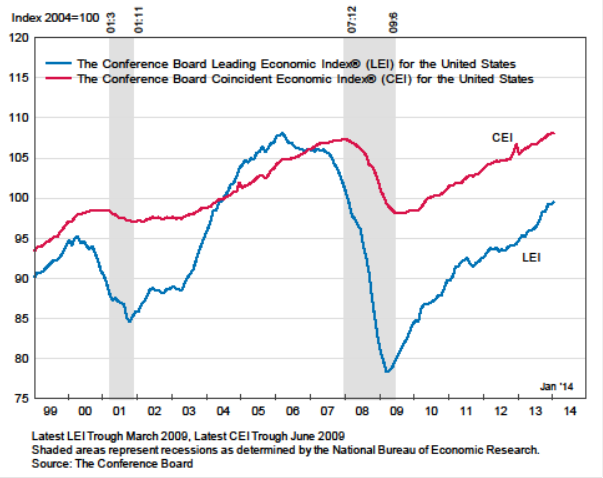
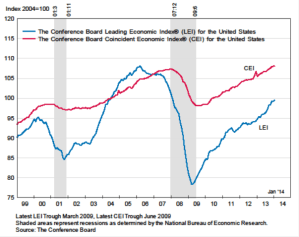
(+) The Conference Board’s index of leading economic indicators rose +0.3% in January, which was an improvement on the flat December.  Positive inputs originated from unemployment claims and financial indicators (like interest rate spreads), while building permits, manufacturing activity/hours and ISM new orders were a negative input.  The coincident and lagging indexes also rose, +0.1% and +0.3% respectively.  As we can see, despite the monthly noise, the longer-term trend is fully intact.
Economic Update 2-24

(+) Initial jobless claims for the Feb. 15 ending week fell just slightly, by 3k to 336k, just a tick higher than expectations calling for 335k.  Continuing claims for the Feb. 8 week rose by 37k to 2,981k, which was a bit higher than the 2,970k expected.

The FOMC minutes from the January meeting were as expected for the most part, other than comments from committee participants discussing potential changes to forward guidance language as the unemployment rate nears the pre-set 6.5% threshold.  They all seem to agree that an updated, looser measure is likely appropriate to continue the easing message; however, no one seemed to agree on how to do it.  Some commentators took this as a ‘hawkish’ indicator, in that rate increases could be closer to reality than initially thought, but a closer look at the wording doesn’t necessarily hint at this (however, a speech given later in the week by Dallas Fed president Richard Fisher may have given that impression).  Tapering was mentioned, mostly in the tone that committee members believe it should continue as planned barring any significant changes to the underlying data or outlook—so a continuation of the asset purchase wind-down remains the default choice.

The argument to raise the federal minimum wage over several steps from $7.25 to $10.10 hit somewhat of a speed bump as the Congressional Budget Office claimed doing so might offer mixed results.  On one hand, it claimed a potential lift of 900k families out of poverty and raising the standard of living for 16.5 million current low-wage workers (15% of the total workforce); on the other hand, it could eliminate 500k jobs from the economy.  The less dramatic ‘$9.00’ minimum wage option naturally resulted in a lessened impact in both the positives and negatives.

This is a politically-charged area of debate, and a testy economic one as well.  Classic economics tells us that setting minimum wage levels (or any type of ‘artificial’ price on a good or service, for that matter) isn’t efficient.  In the Laissez-Faire school of thought, if market forces are left to their own devices, workers are paid according to their individual economic value as well as prevailing supply and demand forces.  So, if there happens to be a glut of low-skill workers, employers keep the upper hand and can pay the lowest possible wage workers will accept (and have often done so historically).  However, this situation can create some other problems, such as if the market wage falls below the cost of living, so if this mismatch gets too extreme, it can lend itself into a catalyst for social unrest.  In the last century, this led to the creation of trade unions and legislating minimum per hour pay standards in several nations in the late 19th and early 20th centuries (New Zealand and Australia were first, followed by several U.S. states, such as Massachusetts, before it was done federally in a wave of Great Depression-era legislation in 1938).

While some economists have suggested that higher minimum wage levels increase unemployment for younger and lower-skill workers—essentially pricing them out of the workforce—the view is far from unanimous.  Other economists and political operators feel the social benefits of a ‘living wage’ outweigh the costs.  And, like many conditions in economics, the results aren’t measurable with precision due to the confluence of other factors involved.

Business behavior is somewhat predictable, though, in that owners seek to consistently maximize profits and keep expenses as low as possible.  For many (or even most) firms, payroll represents the largest operating expense, so an increase in required hourly pay either requires a shrinkage of profit margins (owners no doubt bristle at this prospect) or other adjustments.  To keep the payroll cost math constant, changes could include simply using fewer workers at a higher per-hour rate as opposed to more of the lower-paid variety.  If this happens often enough, the impact could certainly get to the 500k estimated jobs lost.  It wouldn’t necessarily be this extreme, or it could be worse, but these impacts would start at the micro-level.

Period ending 2/21/2014

1 Week (%)

YTD (%)

DJIA

-0.27

-2.46

S&P 500

-0.08

-0.34

Russell 2000

1.35

0.19

MSCI-EAFE

1.57

0.65

MSCI-EM

0.20

-4.33

BarCap U.S. Aggregate

0.08

1.53


U.S. Treasury Yields

3 Mo.

2 Yr.

5 Yr.

10 Yr.

30 Yr.

12/31/2013

0.07

0.38

1.75

3.04

3.96

2/14/2014

0.02

0.32

1.53

2.75

3.69

2/21/2014

0.05

0.33

1.56

2.73

3.69

Posted in Economic News | Tagged , , , , , , | Leave a comment